Tuesday, September 14, 2010

Coverage Ink/Cyberspace Open Newsletter 9-2010


CYBERSPACE OPEN WINNERS! edition

1) Shorties
2) Test Your Screenwriting IQ by Steve Kaire
3) “Save the Cat!” Beat Sheet Weekend Review
4) Reaching the 'Summit': interview with InkTip founder Jerrol LeBaron

Hey, kids!

Okay, I admit it. I've thrown in the proverbial towel, capitulated, given up. After three years of doing our newsletter as an all-text thing, it's time to move into the late 20th century. Our newsletter is now online. Why? Well, problem is that every month we got letters from folks saying the newsletters were formatted weird or unreadable. We experimented with some of the big newsletter services but found their formats way too limiting. To me, this newsletter is like a mini magazine. I want all the articles to run as long as they need to run without needing to break them into bite-sized portions to accommodate some arbitrary newsletter style sheet.

So our monthly newsletter is now on our blog. This ensures everyone can read it, and (gasp) allows us to actually include photos (see, that's me on the left,) art, bolding and underlining and other things we could not do in text-only. So I hope you guys like this move. Let me know if anyone has any difficulty reading any of this (though we'll likely not do anything about it.)

It is now September, and I know many of you slacked this summer. Quite a few of you told me you were taking a "chillax" break from writing (for those of you not down with the lingo of the young'uns, that means a refrigerated hand axe.) Well, I'm here to say: get off your duffs! Your careers are not going to launch themselves. And while I totally get the need to recharge the batteries, there's also a time to become cantankerous and neurotic, to close the blinds, wall off from the rest of the world and submerge back into your art. That time is now. Believe me, I know it's the easiest thing in the world to continue the no-productivity streak once you get rolling. Things like job, income, kids, marriage, all that crap that takes valuable time away from your screenwriting, it has a way of suddenly seeming "important." We start to feel like we can't possibly make time to write, just because our significant other is threatening to leave if they don't get some of your time. Ridiculous! Being a screenwriter is about sacrifice. You knew this going in. It means, among other things:
  • Spending lots of money on books, DVDs, coverage, pitch fests, classes, online postings, etc.
  • Devoting free time to "writing" that could be better spent watching Sportscenter or playing online poker
  • About a decade, sometimes more, of throwing sh** against the wall before you get any traction
  • Suffering through meaningless day jobs and giving up potential real careers so as to focus on writing
And last but definitely not least:
  • Endless amounts of butt-pummeling rejection
Every now and again, we writers feel like we'd like to partake of the perks some of our corporate machine-employed acquaintances enjoy, like a regular, non-subsistence-level paycheck, dental care and vacations that you can actually pay for to places not actually on this continent. We get sick of the sacrifice, the years of hard labor rewarded only by, "Eh, pass." We feel entitled, damn it, to enjoy just a little taste of the life everyone else seems to enjoy. Well, forget it! That is not for us, my friends. We are a different ilk. We are writers. And that means we slave away at our barista or crappy office job (and phone it in.) We do not spend our time fraternizing or being sociable, but rather, being insular and driven (hey, it takes a lot of concentration to create universes.) Our non-industry friends and family members secretly think we're wasting our lives and live in dread that we'll eventually hit them up for a loan or a part-time job at their frozen yogurt shop. But that's their problem!

All of which is to say: most of us probably knew going in that this was going to suck. Yet we all selected this life anyway, because we're masochists or idiots or geniuses, because we feel we can tell stories worth being told, that we've got the goods to keep audiences in their seats, and that despite the endless smackdowns, we will always pop right back up again like a freakin' inflato-clown punching bag, fueled by confidence that someday, somehow, our talent will prevail despite constant reassurances otherwise. And that is what makes us freaking special.

So: suck it up and get back to work! Dig into that rewrite you've been avoiding, beat out that outline, and get your groove back, Stella. The world will reward you -- oh, in about ten or 15 years. Oh, and if you've guessed that this screed is but a thinly veiled excuse to try to motivate my own lazy ass into gear -- you are absolutely right ;)

+++

We've got some cool articles for you all this time out, including the inaugural column from Hollywood high-concept guru Steve Kaire. We sent one of our team to the Blake Snyder's Save the Cat! Beat Sheet weekend, and  we've got the deets and a review. We've got the winners of the Spring Cyberspace Open and updates on the upcoming Cybersapce Open Fall 2010. Last but not least, we've got the full skinny on the upcoming inkTip Pitch Summit and an exclusive interview with inkTip founder Jerrol LeBaron. It's all coming at you... right now.

Onward and downward!

Jim Cirile
Founder, Coverage, Ink
The Industry Experts

Friend us on Facebook!

* * * * * * * * * *

1)

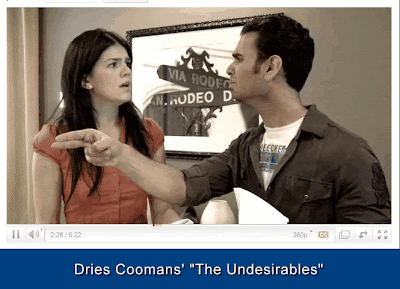
CYBERSPACE OPEN WINNERS. Alas, we didn't get to let all of you know about the voting of the top 3 Spring Cyberspace Open scenes since it happened between newsletter cycles. (Hopefully all of you heard about the voting through the Creative Screenwriting blasts. We here at CI don't do blasts.) But the voting has been closed (but you can still watch the top three scenes right here.) Congrats again to top three finalists Ian Murillo, Lisa Scott and Dries Coomans. The votes have been tallied, and... drum roll, please...


First Place
Dries Coomans – Undesirables - Sao Paulo, Brazil

Second Place
Lisa Scott - Breach of Confidence - Psychiatric Office

Third Place
Ian Murillo - Untitled - Vietnam War setting

Coomans' gritty and gripping scene depicting a troubled, homeless Brazilian teenager who inadvertently kills a man resonated with many of you. Congratulations to all three finalists, and, Dries, you will soon be $3,000 richer. Nice work!

Think you can do better? Well, soon you'll get the chance to step up, because the Open is coming around again next month (registration begins mid-October.) The dates have not been finalized yet, but we'll let you know via newsletter and blog updates as soon as everything has been ironed out.

GOOD, "HARD" NEWS. Screenwriter Patrick Lewis just let us know his screenplay THE HARD YARDS just made the Scriptapalooza top 100! Patrick sends his thanks to CI reader JT for his help. "JT went out of the way to write 20 full pages of notes - well beyond what was expected. He approached my script with passion which is exactly what you need from this kind of a service. Based SOLELY on his notes, I went about making as many changes as I could to align it with his sentiments. Long story short, this draft made it into this years top 100 Semi-finalists for Scriptapalooza - plucked from obscurity you man helped me give it the focus it needed." Hope you've been resting your leg up, Patrick, because you're going to kick a lot of ass. Nice work!

ARFY TO THE RESCUE. CI newsletter reader Jeanne McKinney asked if we could share this with you all: "Hi Jim, my partner and I just produced an independent film TRACKERS featuring search and rescue dogs in San Diego. We're excited to offer this YouTube link to promote search dogs and their vital role. We’re asking everyone to invite their social network to visit the site and vote! Also, we entered it in Next Web Series and Short Film Competition – Will get seen by a powerful judging panel, incl. people with associations with Disney, Animal Planet, Discovery, National Geographic, History Channel, Fox etc. It’s about good people and animals doing good things for their neighbors – all for free. A bright light in a world of filled with increasing negativity and chaos." Best of luck, Jeanne!

DROP EVERYTHING AND READ THIS RIGHT NOW. What does it take to get a Recommend/ Recommend with Coverage Ink? You can start by being Matt Zien. Matt's script LOVE AND CANDY garnered that super-rare honor, and our blog post about it landed him three industry submissions (Hey, people read our blog! Who knew?) -- two prodcos and red-hot management firm Roar. Way to go, Matt!

NOT TO BE OUTDONE...On the TV side, Susan J. Boyer's MAD MEN spec "Good Mourning" scored a Strong Consider/Strong Consider, and once again our blog post about it led to a request from Roar, who is reading it now. Way to go, you guys!

BEST CONTEST WITH NO PRIZES -- PLUS RAFFLE! Why do we love TrackingB.com ? Because they are the real deal --a real-life industry tracking board used by actual industry types, that you can subscribe to. What the heck is the point of that? Well, you're all students of the business, right? (You'd better be if you want to have a chance in Hollywood.) Every time there's any sort of literary activity in town, from specs going out to open assignments to executive shuffles, it hits the tracking boards. As a fly on the wall, you will glean potentially invaluable insider information. Also very useful for finding out if there is already a project in development similar to the one you were about to begin! And they have a contest. No cash prizes or seminars or anything like that. Instead, their top picks get read by an amazing panel of industry heavyweights. Who needs a cash prize when what we really want is access, right? TrackingB's "The Insider" says: "We've lined up our strongest industry panel yet (Bruckheimer Films, Imagine, Mike Esola-WME, etc.), and all three of our finalists last year got repped out of it.") Check 'em out right here.

Hey, how about a chance to enter the TrackingB.com contest for free? We're raffling off one free entry to CI newsletter readers. Just e-mail us at info@coverageink.com and put TRACKINGB in the subject line (and your name and contact info in the body of the mail.) We'll randomly draw one winner and announce it next month!

BUILDING TO CRESS-CENDO. Five years ago, Cressandra Thibodeaux took the top prize in the CS Open live writing tournament. She's back in her native Houston, teaching screenwriting (using examples from the CS Open!) She's also opened her own microcinema -- a theater specializing in low-budget and indie films. Check out this article about Cress and her 14 Pews Cinema right here. She has big plans, including launching a festival promoting films with Latino and local content. If you've got a great indie film, especially one with Texas or Latino themes, snail mail a DVD to: Cressandra Thibodeaux, 14 Pews, 800 Aurora Street, Houston, Texas 77009.

GET LIBERATED. As many of you know, we put our own contest (Writers on the Storm) on hold this year in order to focus on other creative projects, not the least of which is getting a movie made. LIBERATOR will be Coverage Ink's second film, and we're happy to report some amazing developments. Originally conceived as a short, LIBERATOR is now a feature with a $1 million budget. Liberator co-creator Aaron Pope is directing, with Stephen Sweeney (HOUSE) producing. Even more exciting: VFX will be handled by STROB, whose work on the internet phenomenon IRON BABY has netted over 5 million views. We'll have more on this superhero/dark political action/thriller as it develops!

JUST THE FLAX, MAN WINNER. Last month we raffled off leading screenplay consultant Robert Flaxman's 90-minute DVD “Seducing the Studio Reader." Over seventy of you responded, and the randomly chosen winner (we used random.org's random number generator) is... JON BRADFORD! Congrats, Jon! Robert will be sending your DVD right out to you. Holler back after you watch it and let us know what you think.

RATING THE PITCH FESTS. We're doing a quick survey to gauge your opinions on the various pitch festivals. Please let us know if you've attended/utilized any of these below and how you feel about them. We will use this data in an upcoming article for Script magazine. Thanks for your time!

Please rate the following pitch fests/pitch services from 0 to 5 (5 being best). If you did not attend an event/use this service, please leave it blank. Cut and paste it into a mail and send back to us at info@coverageink.com by 10-1-10 and put SURVEY in the subject line. Thanks!

1) Golden Pitch Festival (Screenwriting Expo)
_____ Organization
_____ Customer Service
_____ Value
_____ Overall Experience
_____ Results

2) Great American Pitchfest/Great Canadian Pitchfest
_____ Organization
_____ Customer Service
_____ Value
_____ Overall Experience
_____ Results

3) Hollywood Pitch Festival (Fade In)
_____ Organization
_____ Customer Service
_____ Value
_____ Overall Experience
_____ Results

4) inkTip Pitch Summit
_____ Organization
_____ Customer Service
_____ Value
_____ Overall Experience
_____ Results

5) Virtual Pitchfest
_____ Organization
_____ Customer Service
_____ Value
_____ Overall Experience
_____ Results

6) Pitch Q
_____ Organization
_____ Customer Service
_____ Value
_____ Overall Experience
_____ Results

Please provide us with any specific comments or feedback on any of these events or services, or any others you may have attended. Thank you!

* * * * * * * * * *

2) TEST YOUR SCREENWRITING IQ (Part 1)

by Steve Kaire

We are pleased to present a new monthly column by Hollywood's resident high-concept guru Steve Kaire. (We reviewed Kaire's audio CD last month -- check it out right here. With eight studio sales under his belt and decades of experience in the biz, Kaire knows whereof he speaks. Enjoy! --Jim Cirile

+++

True or False:

1. Literary agents are eager to add new writers to their client list.

That’s false. Agents are busy enough handling their present clients and don’t take on new clients very often. The exception is when a writer achieves success on his own, and then the agents come calling. The other exception is when a person whom the agent respects recommends that the agent look at a writer’s material with the possibility of representing him.

2. Options are generally a good deal for screenwriters.

False. Options are a bad deal for writers. For very little money, the writer can’t pitch his project to anyone for the length of the option. And when the option is up, the company optioning the material has usually failed to set up the project and years have been wasted.

3. Half the members of the Writer’s Guild earn no income from their writing each year.

Unfortunately, that is true.

4. High Concept is any big budget film.

That’s false. High Concept is not related to budgets at all. A "high concept" is an original story idea with mass appeal that can be pitched in a few sentences.

5. A rejected screenplay can be resubmitted to the same company after revisions.

False. You have only one shot with each company you submit to.

6. Dramas are one of the most difficult genres to sell.

True. Dramas are a difficult sell because they are execution-driven, rather than pitch-driven. You have to read the scripts to appreciate them.

7. Verbal contracts are just as enforceable as written contracts.

False. Verbal agreements are legal contracts, but it comes down to one person's word against another. Get everything in writing so there are no misunderstandings.

8. There is a lot of theft of material in Hollywood.

False. Contrary to public opinion, theft of material does happen, but it occurs far less frequently than people think. It’s much cheaper to acquire material legally than steal it, avoiding lawsuits and bad publicity.

9. The writing and rewriting of a screenplay is generally a one to two-year investment of time.

Very true.

10. Never sign a release form because you are signing your rights away.

False. Signing release forms is sometimes the only way to get your material read by production companies and studios.

Any of these shake up your pre-conceived notions? Check out Part 2, coming next month right here on the CI blog/newsletter!

+++

Steve Kaire is a Screenwriter/Pitchman who’s sold 8 projects to the major studios without representation. His top-rated CD, “High Concept – How to Create, Pitch & Sell to Hollywood” is available on his website along with original articles, contests and plenty of other information of use to writers. HighConceptScreenwriting.com


* * * * * * * * * *

3) SO MANY CATS TO SAVE. SO LITTLE TIME.

SAVE THE CAT! BEAT SHEET WORKSHOP REVIEW

by Ebony Jones

I recently took advantage of the fascinating opportunity to take part in Blake Snyder's Save the Cat! Beat Sheet Weekend Workshop. If I had to come up with a simple and poignant way to describe it, I'd call it the only workshop that you'll ever find in Hollywood that encourages your story's individuality. Remember that scene in the The Wall when the kids are on a conveyor belt and ground up in the meat grinder only to resurface as “clones” of one another? Well, I have been to other screenwriting workshops that reeked of the meat factory stench. That's definitely not the experience of The Beat Sheet Workshop.

For two straight days (and eight to nine hours a day), you're in a room with nine other people pouring out all the mental energy you have left to get them to care about your script. Weeks before, as I read Blake Snyder's "Save the Cat! Strikes Back", wherein he discussed his workshops, I thought to myself that I could never attend one of these. I had envisioned myself in this room with these amazing writers, squirming in my seat plotting out my exit strategy instead of my script. I just knew I'd be on the outside looking in on some secret society of the screenwriting world. My fears were proven wrong.

With Blake Snyder's passing in 2009, the workshops are now lead by the very thorough and knowledgeable Jose Silerio. He wasn't fumbling through notes, he didn't preach to us, and he wasn't trying to be Blake. He presented the ideas to us in the best way that he knew them. And his thought processes with every topic were honest and raw. I could tell that Blake's ideas were ingrained in Jose's heart.

Jose started out by telling us that it didn't matter whether we were novices or professionals, every one of us was starting from the same blank page. And that's an important attitude to have when you come in. Amongst the group, the common want at the start of the workshop was to just finish a script. But the common need at the end was to go forth and write the best screenplay we could write. There was no longer any doubt that we'd finish it.


On day one, all you need to bring in the door is one or two (I'd say two at the most) ideas. And the goal of day one is just the logline and the three most important parts of the beat sheet (the opening image, the midpoint, and final image). On day two, the goal is to beat out all 15 beats with your chosen logline. About an hour was spent per story idea to hopefully help the screenwriter get the story to the next step of 40 cards and then the 110 screenplay pages. No one was rushed during the discussion sessions. The conversations flowed from one to the next. Even if an idea didn’t seem like it was going to work, nine others put our heads together to come up with solutions. There was no way we were letting anyone’s potential screenplay fall to the wayside. As Blake said in Save the Cat! Strikes Back, most screenplays, even the bad ones, can be recovered with the 15 beats and 40 cards.

I must explain my experience with the The Beat Sheet Workshop on an emotional level. My father is a recovered alcoholic. I once asked him after his 30-day stint in rehab, what did his world look like when he left that place? He said that when you're in rehab, you're surrounded by people that are just like you. You've all made the same mistakes. And you're all there to make systematic changes so that the rest of your life's story isn't so cloudy. But the most important thing, he said, was that everyone in rehab cares just as much about your sobriety as you do. So you take those 12 steps and you tailor them to your life's story. And though you are guaranteed different outcomes from the guy or girl that sat next to you in rehab, both stories will be brilliant. Recovery is brilliant, but the first steps out of rehab leave you panicked and afraid of the world on the outside.

When I walked out of the workshop on the last day, I felt exactly the same as my father described. Jose, Bruce, Carran, David, Doug, Karen, Rick, Rebecca and Stephen were the helpers that aided the recovery of my script. But we all came in with the same ailments of unstructured and horrible storytelling. And Jose, with Blake’s words of wisdom, took us through those 15 beats. On day one, there were some fears amongst us all that the outcomes would be the same since we were working with the same base formula. But by day two, we proved ourselves wrong because our efforts led to some brilliant and diverse script recoveries with the help of the same 15 beats.

Needless to say, I recommend a Beat Sheet Workshop with Jose. Know in your heart that you will not fail when it's time to go and you step out those doors to write that script. Your new comrades will be there if you fall off beat and need a helping hand to get back on track. Maybe even ask one of them, whoever you felt really “got” your story, to be your guide from page 1 Fade In: through page 110 Fade Out, and then present it to whole group again. Trust me -- they won't ask you for more than just movie tickets to the premiere. And that's a promise you want and need to keep.

Thank you, Blake and Jose, for the experience and support system.

Ebony Jones is a 2001 graduate of Cornell University's School of Hospitality with a degree in business communications. She has completed her first unpublished novel "Swimming in Blue Drink" as well as a short story, “When Ariel Lost Her Voice”. She is finally going to tackle restructuring the dramatic screenplay she's been working on titled “When Momma Dies”.

* * * * * * * * * *

4) REACHING THE "SUMMIT"
Interview with inkTip's JERROL LeBARON

by Jim Cirile

Jerrol LeBaron is the founder of inkTip (www.inkTip.com,) the leading site for screenwriters to post their material online. After over a decade of success stories, inkTip is now launching the inkTip Pitch Summit in Los Angeles September 25th and 26th. Registration closes THIS FRIDAY 9-17, so this is your last chance to get in on this event. We spoke to LeBaron about how and why he intends Pitch Summit to set a new high bar for pitch festivals. Meeting 35 producers in a single day? LeBaron says it can happen. Read on...

Jim Cirile: Hi, Jerrol. Can you tell us a little bit about your background and how you got the idea for inkTip?

Jerrol LeBaron: I’ve basically lived in L.A. all my life. I had other businesses -- I was a general contractor, I had a jewelry business. I decided to dabble in acting and screenwriting. I wrote a screenplay, and I had a great deal of difficulty in marketing it. I thought, wouldn’t it be cool if we could set up something on the internet so that writers could get exposure and producers could find what they’re looking for? ‘Cause I found that producers had the same problem writers did. They were looking for that perfect screenplay, and oftentimes they could not find it. And writers, you know, the whole catch-22 in Hollywood is you have to have an agent before you can sell your screenplay, but before you can sell your screenplay, you have to have an agent. Developing inkTip turned out to be the ideal solution for that, because it gave every screenwriter the opportunity to get the exposure they want. At the same time, it gave producers who were thinking outside the box – you know, sometimes to find that right screenplay, you might have to know 20, 30, 40 different agents. If you don’t know them all, you’ve greatly reduced the odds of finding what you’re looking for.

JC: It wasn’t originally called inkTip, right?

JL: Right. The first name was Writers Script Network. There was another name similar to ours, so we ended up changing it to inkTip, which certainly was a lot easier to type out. Our focus really has been getting exposure to writers and getting results. We average four screenplays a week that are either sold or optioned or the writer’s gotten hired or gained representation. We get about 20 movies made a year. Our concentration is on results.

JC: I think a lot of people don’t understand that there are tiers within the producing community. There’s the big high-up mucky-mucks who are serviced by agents and managers, and then there’s everybody else who don’t necessarily have that same level of access to the CAA scripts that are going out. But those are the guys who are getting deals done, getting movies made, who still have to prove themselves. How did you go about contacting all these producers in the first place to tell them, hey, check our site out?

JL: I didn’t personally have the contacts in the industry to start it off. It was just a lot of legwork -- calling them, meeting with them, doing whatever it takes to get them to see that this is something that will work for them.

JC: When you got started, the internet itself was still pretty new.

JL: That’s right. The internet was unproven at the time. (In the beginning,) of the thousands of production companies out there, maybe 150 actually used the internet to search for screenplays. Now we’ve got about 2,000. It was slow going (laughs.) We’ve been going for a little over ten years now.

JC: So it’s proven now, it’s viable and you have an enviable success record. Why move into pitch fests?

JL: The more we expand, the more producers find out about us. By doing Pitch Summit, it’s inevitable that other producers will find out about us. We’re having industry professionals that we’ve never had contact with who are very qualified coming aboard.

JC: So the Pitch Summit cross-promotes the regular site too, which is good news for everybody.

JL: Right. I am always looking for ways to get better exposure for writers on inkTip. But in addition to that, I saw in the various pitch events that the results weren’t as abundant as I would like. If you go to a pitch event and you’re only able to pitch five or eight production companies, that is just not enough. So my focus is increasing the numbers. You have much better odds if you’re able to see 30 or 35 production companies or agencies.

JC: How can people get 30-plus meetings in a single day?

JL: It’s simple. We’ve made our pitch day a little bit longer, but at the same time, we’ve greatly reduced the ratio. For example, instead of there being ten writers for every production company, we’re bringing almost 200 production companies and we expect about 400 writers. Each pitch session is five minutes. Of course there are going to be lines with some of them, but we’re greatly reducing the ratio so that you have the opportunity to pitch 30, 35 companies.


JC: How do you get these companies to show up?

JL: The same way any other pitch fest does -- you pay ‘em a fee. Now one (incentive for them) is that we’re only allowing writers that have completed, polished screenplays. That’s one thing that’s a real turn-off for production companies is that they go to a pitch event, and they end up sitting with someone who’s never even written a screenplay and who’s got their pitch on a napkin. That’s maybe slightly exaggerated, but not much.

JC: That’s great to hear, because whenever I ask industry friends about pitch fests, you get that sort of collective groan, because they know most of the pitches are going to be amateur hour. So how do you screen the writers?

JL: A lot of the screenplays are already on our site, but we have a lot of other writers who’ve never used (inkTip.com,) and we see their screenplay. I’m not saying we read them through, but we verify they have a completed screenplay. We want our producers and agents to know that they’re only going to get people who have completed, polished screenplays. That’s why we have companies contacting us now, whom we never reached out to, who’ve heard about the Pitch Summit and want to be a part of it.

JC: This is a massive undertaking. Just the rental of the Universal Sheraton ballroom must cost a fortune. This is a huge dice-roll for you guys, isn’t it?

JL: The nail-biting is ongoing (laughs.) Fortunately because of inkTip, we already have access to lots of producers and writers.

JC: Thanks so much for taking the time, Jerrol. Any final advice for folks who are thinking of attending Pitch Summit?

JL: The best way for people to maximize their chances is, we’re going to have studio companies there and big agencies. But if you only look for them, but those folks already have a lot of clientele and projects, and if they already have something similar to that, there’s no reason for them to look at a writer. What I would suggest is that you pitch whoever you can. Go to the smallest lines. The chance of getting recognized by the big guys is much more slight than by somebody who doesn’t have the roster.

* * * * * * * * * *

Thanks for reading! Questions? Comments? Shoot us an e-mail at info@coverageink.com.

All content is copyright 2010 by Coverage, Ink. Writers on the Storm Screenplay Competition is a registered trademark of Coverage, Ink. Cyberspace Open is a registered trademark of Creative Screenwriting magazine.

You have received this mail because you are either a Coverage, Ink client, a Writers on the Storm contestant or you have participated in the CS Open Writing Tournament. We do not wish to spam anybody! This newsletter is the ONLY thing you will ever get from us -- and we will never sell your name to a list.

If you have received this e-mail in error, or do not wish to receive e-mails from us, please e-mail info@coverageink.com and enter DELETE in the subject line -- and we’ll make sure you’re removed immediately.

Monday, September 13, 2010

REACHING THE "SUMMIT"

Interview with inkTip's JERROL LeBARON

by Jim Cirile

Jerrol LeBaron is the founder of inkTip (www.inkTip.com,) the leading site for screenwriters to post their material online. After over a decade of success stories, inkTip is now launching the inkTip Pitch Summit in Los Angeles September 25th and 26th. Registration closes THIS FRIDAY 9-17, so this is your last chance to get in on this event. We spoke to LeBaron about how and why he intends Pitch Summit to set a new high bar for pitch festivals. Meeting 35 producers in a single day? LeBaron says it can happen. Read on...

Jim Cirile: Hi, Jerrol. Can you tell us a little bit about your background and how you got the idea for inkTip?

Jerrol LeBaron: I’ve basically lived in L.A. all my life. I had other businesses -- I was a general contractor, I had a jewelry business. I decided to dabble in acting and screenwriting. I wrote a screenplay, and I had a great deal of difficulty in marketing it. I thought, wouldn’t it be cool if we could set up something on the internet so that writers could get exposure and producers could find what they’re looking for? ‘Cause I found that producers had the same problem writers did. They were looking for that perfect screenplay, and oftentimes they could not find it. And writers, you know, the whole catch-22 in Hollywood is you have to have an agent before you can sell your screenplay, but before you can sell your screenplay, you have to have an agent. Developing inkTip turned out to be the ideal solution for that, because it gave every screenwriter the opportunity to get the exposure they want. At the same time, it gave producers who were thinking outside the box – you know, sometimes to find that right screenplay, you might have to know 20, 30, 40 different agents. If you don’t know them all, you’ve greatly reduced the odds of finding what you’re looking for.

JC: It wasn’t originally called inkTip, right?

JL: Right. The first name was Writers Script Network. There was another name similar to ours, so we ended up changing it to inkTip, which certainly was a lot easier to type out. Our focus really has been getting exposure to writers and getting results. We average four screenplays a week that are either sold or optioned or the writer’s gotten hired or gained representation. We get about 20 movies made a year. Our concentration is on results.

JC: I think a lot of people don’t understand that there are tiers within the producing community. There’s the big high-up mucky-mucks who are serviced by agents and managers, and then there’s everybody else who don’t necessarily have that same level of access to the CAA scripts that are going out. But those are the guys who are getting deals done, getting movies made, who still have to prove themselves. How did you go about contacting all these producers in the first place to tell them, hey, check our site out?

JL: I didn’t personally have the contacts in the industry to start it off. It was just a lot of legwork -- calling them, meeting with them, doing whatever it takes to get them to see that this is something that will work for them.

JC: When you got started, the internet itself was still pretty new.

JL: That’s right. The internet was unproven at the time. (In the beginning,) of the thousands of production companies out there, maybe 150 actually used the internet to search for screenplays. Now we’ve got about 2,000. It was slow going (laughs.) We’ve been going for a little over ten years now.

JC: So it’s proven now, it’s viable and you have an enviable success record. Why move into pitch fests?

JL: The more we expand, the more producers find out about us. By doing Pitch Summit, it’s inevitable that other producers will find out about us. We’re having industry professionals that we’ve never had contact with who are very qualified coming aboard.

JC: So the Pitch Summit cross-promotes the regular site too, which is good news for everybody.

JL: Right. I am always looking for ways to get better exposure for writers on inkTip. But in addition to that, I saw in the various pitch events that the results weren’t as abundant as I would like. If you go to a pitch event and you’re only able to pitch five or eight production companies, that is just not enough. So my focus is increasing the numbers. You have much better odds if you’re able to see 30 or 35 production companies or agencies.

JC: How can people get 30-plus meetings in a single day?

JL: It’s simple. We’ve made our pitch day a little bit longer, but at the same time, we’ve greatly reduced the ratio. For example, instead of there being ten writers for every production company, we’re bringing almost 200 production companies and we expect about 400 writers. Each pitch session is five minutes. Of course there are going to be lines with some of them, but we’re greatly reducing the ratio so that you have the opportunity to pitch 30, 35 companies.


JC: How do you get these companies to show up?

JL: The same way any other pitch fest does -- you pay ‘em a fee. Now one (incentive for them) is that we’re only allowing writers that have completed, polished screenplays. That’s one thing that’s a real turn-off for production companies is that they go to a pitch event, and they end up sitting with someone who’s never even written a screenplay and who’s got their pitch on a napkin. That’s maybe slightly exaggerated, but not much.

JC: That’s great to hear, because whenever I ask industry friends about pitch fests, you get that sort of collective groan, because they know most of the pitches are going to be amateur hour. So how do you screen the writers?

JL: A lot of the screenplays are already on our site, but we have a lot of other writers who’ve never used (inkTip.com,) and we see their screenplay. I’m not saying we read them through, but we verify they have a completed screenplay. We want our producers and agents to know that they’re only going to get people who have completed, polished screenplays. That’s why we have companies contacting us now, whom we never reached out to, who’ve heard about the Pitch Summit and want to be a part of it.

JC: This is a massive undertaking. Just the rental of the Universal Sheraton ballroom must cost a fortune. This is a huge dice-roll for you guys, isn’t it?

JL: The nail-biting is ongoing (laughs.) Fortunately because of inkTip, we already have access to lots of producers and writers.

JC: Thanks so much for taking the time, Jerrol. Any final advice for folks who are thinking of attending Pitch Summit?

JL: The best way for people to maximize their chances is, we’re going to have studio companies there and big agencies. But if you only look for them -- those folks already have a lot of clientele and projects, and if they already have something similar to that, there’s no reason for them to look at a writer. What I would suggest is that you pitch whoever you can. Go to the smallest lines. The chance of getting recognized by the big guys is much more slight than by somebody who doesn’t have the roster.

***

Return to newsletter

Friday, September 10, 2010

So Many Cats to Save. So Little Time.

Save the Cat! Beat Sheet Workshop Review

by Ebony Jones

I recently took advantage of the fascinating opportunity to take part in Blake Snyder's Save the Cat! Beat Sheet Weekend Workshop. If I had to come up with a simple and poignant way to describe it, I'd call it the only workshop that you'll ever find in Hollywood that encourages your story's individuality. Remember that scene in the The Wall when the kids are on a conveyor belt and ground up in the meat grinder only to resurface as “clones” of one another? Well, I have been to other screenwriting workshops that reeked of the meat factory stench. That's definitely not the experience of The Beat Sheet Workshop.

For two straight days (and eight to nine hours a day), you're in a room with nine other people pouring out all the mental energy you have left to get them to care about your script. Weeks before, as I read Blake Snyder's "Save the Cat! Strikes Back", wherein he discussed his workshops, I thought to myself that I could never attend one of these. I had envisioned myself in this room with these amazing writers, squirming in my seat plotting out my exit strategy instead of my script. I just knew I'd be on the outside looking in on some secret society of the screenwriting world. My fears were proven wrong.

With Blake Snyder's passing in 2009, the workshops are now lead by the very thorough and knowledgeable Jose Silerio. He wasn't fumbling through notes, he didn't preach to us, and he wasn't trying to be Blake. He presented the ideas to us in the best way that he knew them. And his thought processes with every topic were honest and raw. I could tell that Blake's ideas were ingrained in Jose's heart.

Jose started out by telling us that it didn't matter whether we were novices or professionals, every one of us was starting from the same blank page. And that's an important attitude to have when you come in. Amongst the group, the common want at the start of the workshop was to just finish a script. But the common need at the end was to go forth and write the best screenplay we could write. There was no longer any doubt that we'd finish it.


On day one, all you need to bring in the door is one or two (I'd say two at the most) ideas. And the goal of day one is just the logline and the three most important parts of the beat sheet (the opening image, the midpoint, and final image). On day two, the goal is to beat out all 15 beats with your chosen logline. About an hour was spent per story idea to hopefully help the screenwriter get the story to the next step of 40 cards and then the 110 screenplay pages. No one was rushed during the discussion sessions. The conversations flowed from one to the next. Even if an idea didn’t seem like it was going to work, nine others put our heads together to come up with solutions. There was no way we were letting anyone’s potential screenplay fall to the wayside. As Blake said in Save the Cat! Strikes Back, most screenplays, even the bad ones, can be recovered with the 15 beats and 40 cards.

I must explain my experience with the The Beat Sheet Workshop on an emotional level. My father is a recovered alcoholic. I once asked him after his 30-day stint in rehab, what did his world look like when he left that place? He said that when you're in rehab, you're surrounded by people that are just like you. You've all made the same mistakes. And you're all there to make systematic changes so that the rest of your life's story isn't so cloudy. But the most important thing, he said, was that everyone in rehab cares just as much about your sobriety as you do. So you take those 12 steps and you tailor them to your life's story. And though you are guaranteed different outcomes from the guy or girl that sat next to you in rehab, both stories will be brilliant. Recovery is brilliant, but the first steps out of rehab leave you panicked and afraid of the world on the outside.

When I walked out of the workshop on the last day, I felt exactly the same as my father described. Jose, Bruce, Carran, David, Doug, Karen, Rick, Rebecca and Stephen were the helpers that aided the recovery of my script. But we all came in with the same ailments of unstructured and horrible storytelling. And Jose, with Blake’s words of wisdom, took us through those 15 beats. On day one, there were some fears amongst us all that the outcomes would be the same since we were working with the same base formula. But by day two, we proved ourselves wrong because our efforts led to some brilliant and diverse script recoveries with the help of the same 15 beats.

Needless to say, I recommend a Beat Sheet Workshop with Jose. Know in your heart that you will not fail when it's time to go and you step out those doors to write that script. Your new comrades will be there if you fall off beat and need a helping hand to get back on track. Maybe even ask one of them, whoever you felt really “got” your story, to be your guide from page 1 Fade In: through page 110 Fade Out, and then present it to whole group again. Trust me -- they won't ask you for more than just movie tickets to the premiere. And that's a promise you want and need to keep.

Thank you, Blake and Jose, for the experience and support system.

Ebony Jones is a 2001 graduate of Cornell University's School of Hospitality with a degree in business communications. She has completed her first unpublished novel "Swimming in Blue Drink" as well as a short story, “When Ariel Lost Her Voice”. She is finally going to tackle restructuring the dramatic screenplay she's been working on titled “When Momma Dies”. 

Return to newsletter

Test Your Screenwriting IQ

by Steve Kaire

We are pleased to present a new monthly column by Hollywood's resident high-concept guru Steve Kaire. (We reviewed Kaire's audio CD last month -- check it out right here. With eight studio sales under his belt and decades of experience in the biz, Kaire knows whereof he speaks. Enjoy! --Jim Cirile

+++

True or False:

1. Literary agents are eager to add new writers to their client list.

That’s false. Agents are busy enough handling their present clients and don’t take on new clients very often. The exception is when a writer achieves success on his own, and then the agents come calling. The other exception is when a person whom the agent respects recommends that the agent look at a writer’s material with the possibility of representing him.

2. Options are generally a good deal for screenwriters.

False. Options are a bad deal for writers. For very little money, the writer can’t pitch his project to anyone for the length of the option. And when the option is up, the company optioning the material has usually failed to set up the project and years have been wasted.

3. Half the members of the Writer’s Guild earn no income from their writing each year.

Unfortunately, that is true.

4. High Concept is any big budget film.

That’s false. High Concept is not related to budgets at all. A "high concept" is an original story idea with mass appeal that can be pitched in a few sentences.

5. A rejected screenplay can be resubmitted to the same company after revisions.

False. You have only one shot with each company you submit to.

6. Dramas are one of the most difficult genres to sell.

True. Dramas are a difficult sell because they are execution-driven, rather than pitch-driven. You have to read the scripts to appreciate them.

7. Verbal contracts are just as enforceable as written contracts.

False. Verbal agreements are legal contracts, but it comes down to one person's word against another. Get everything in writing so there are no misunderstandings.

8. There is a lot of theft of material in Hollywood.

False. Contrary to public opinion, theft of material does happen, but it occurs far less frequently than people think. It’s much cheaper to acquire material legally than steal it, avoiding lawsuits and bad publicity.

9. The writing and rewriting of a screenplay is generally a one to two-year investment of time.

Very true.

10. Never sign a release form because you are signing your rights away.

False. Signing release forms is sometimes the only way to get your material read by production companies and studios.

Any of these shake up your pre-conceived notions? Check out Part 2, coming next month right here on the CI blog/newsletter!

+++

Steve Kaire is a Screenwriter/Pitchman who’s sold 8 projects to the major studios without representation. His top-rated CD, “High Concept – How to Create, Pitch & Sell to Hollywood” is available on his website along with original articles, contests and plenty of other information of use to writers. HighConceptScreenwriting.com 

Return to newsletter

Top 8 Financial Tips for Writers

Here's a sidebar piece to an article I wrote for the upcoming issue of Script magazine called "Mo' Money, Mo' Problems" -- about how much one can realistically expect to make as a professional writer and how to protect yourself from it all vaporizing on you. Be sure to pick up the next issue of Script!

--Jim C.

***

Thinking of making some dough writing? (Not a bad idea, that.) Here are some tippers to help you hold on to that hard-earned cash. Sure, they may seem simple, intuitive, and a little “duh.” But our brains do have a tendency to turn off at the most inopportune times (like when making financial decisions.) Tape this list to your forehead!

        1) Embrace Your Inner Skinflint. Just because your wallet’s fat, that doesn’t mean it’s time to live like Diddy. Screenwriting careers can be notoriously short-lived.  At some point, the gravy train will derail. The high life is great for Miller beer, not you. Now is not the time to buy that mansion in Pacific Palisades. Stay cheap!

2)      How Many Reps? If you have both an agent and a manager, God bless you. But each one of them hoovers away 10%. Do you really need both? Maybe, if they’re both amazing and functioning as a team. But what if your manager is doing all the work and your agent doesn’t do jack? A manager and an attorney (at 10% and 5% respectively) might be the move.

3)      Pay Yourself First. It’s easy to forget to spirit away a chunk for yourself when you’re loaded down with debt. Instead: lop 10% off the top (or more if you can) whenever you get a check and tuck it in an IRA, a CD or whatever your favorite investment is. You may only be earning a percent or two, but the main thing is you’re slowly building wealth. Even if it’s only 20 bucks – do it.

4)      Diversify and Conquer. Learn the basics of investing (or find a trusted financial advisor to handle that stuff) and then make like the big boys and have multiple types of investments. Maybe you’ll own some stocks, some mutual funds, shares in non-US companies, maybe even physical gold or silver. This will prevent you from taking too big a hit if any one market or sector, or the entire economy, tanks.

5)      Build a Secondary (non-industry) Revenue Stream. There’s a reason every actor in town owns a restaurant. Consider investing in or starting a business that has nothing to do with the movies. Love baseball cards, crocheting, line dancing, cheese-making? Then start a business involving one of your other passions. If your career ever goes down in flames, you’ll be glad you did.

6)      Get an Accountant Who Knows the Biz. Here in Los Angeles, there are quite a few terrific accountants who not only know their tax law but all about how it applies to writers. Your family accountant in Terre Haute just ain’t gonna cut it. Your accountant becomes your partner in many ways and may even prevent you from making bad financial decisions. Best of all, they generally work for a flat fee, and will often dispense advice at no additional charge.

7)      Get an Income Property. Real estate may not be the surefire investment it once was, but mortgages right now are dirt-cheap. Consider buying an income property such as an apartment building. For example, in a 4-unit building, the rents should cover the monthly costs and make you a little profit on the top. You might even be able to live in one of the units!

8)       Never Pay Retail or Sales Tax! Ah, the wonder of eBay, Craigslist, the Recycler, Amazon marketplace… Why drive to the local Target and pay top-dollar plus the usurious 9.75% Los Angeles sales tax? Order online and save a bundle. You’ll often be able to find the exact same item brand new for less, with either free or cheap shipping, or even better, slightly used at deep discount.

***

It’s all about being having financial foresight and being frugal. Remember that the industry does not care about you. You are chattel to be utilized and then discarded. So even though right now you might be on top of the world and rolling in six-figure paychecks, two years from now you could be desperate and unemployed. Many writers have found themselves burnt by the system, left stunned, despondent and broke! Don’t be one of them. Follow these tips and shore up your financial empire. Good luck!

+++

Jim Cirile is a freelance writer and screenwriter/producer living in Los Angeles. He is the owner of screenplay analysis service www.coverageink.com.

Friday, August 20, 2010

VOTE NOW for the winner of the Cyberspace Open!


Hey folks,

THIS is your chance. Watch the three top-scoring scenes from the Spring 2010 Creative Screenwriting Cyberspace Open and then VOTE on the winner. In this age of Diebold and Premier Voting Systems, this may be your last chance to vote for anything where your vote is actually counted accurately. So vote now!

We proudly present to you the top scenes from 1,500-plus entrants in the Spring Cyberspace Open. Writers were given irritatingly tricky scene parameters and a maddeningly quick turnaround time to write their own interpretation of that scene. The scenes were then evaluated by Coverage Ink's team of readers. The top 3 scorers were then videotaped (directed by Piotr Uzarowicz, scene narration by yours truly) using real actors in staged readings. The results: three very fun, and very different, interpretations of the scene prompt!

Did I mention the winner receives $3,000??? 

The top three scenes:

Undesirables by Dries Coomans 
Roulette by Ian Murillo
Breach of Confidence by Lisa Scott

Go to this page right here and watch the three scenes (they're short!) You may also read the scripts if you like (they're posted as PDFs.) And then... VOTE! Seriously, that's all there is to it. And then get ready, because the Fall Cyberspace Open is coming at you in short order. Think you can do better than these three? Then bring it! Enjoy!

--Jim C.

Thursday, August 12, 2010

Boyer's "Mad" Skillz

Isn't this something? For the second time this week, we've reviewed a knock-it-out-of-the-park home run script. In this case, Susan J. Boyer's "Mad Men" spec "Good Mourning" elicited a very, very rare "high consider/high consider" (excellent) score from Coverage Ink analyst KO (himself a working TV writer.)
‘Mad Men: Good Mourning’ is a nearly flawless spec that stays true to the hit AMC television show. The writer is clearly passionate about the program and nails every nuance and character... It captures these characters, layers in subtext (on countless fronts) and provides effective comic relief to help with the pacing (see Roger once again). The tone matches up with the show (dark and dramatic) and stays even and consistent throughout.
We contacted Boyer with the news. Boyer, who says she's been using Coverage Ink "for, like, ten years" was floored. While she's gotten considers before, this is the first time she's gotten a rave like this. "'Wow' is right!! What amazing coverage, of course, not only for the praise but also for the constructive feedback. Absolutely the reason why Coverage Ink is the only coverage service I have used for the past decade! Getting started on my revision NOW with this road map. I am embarking on AgentQuest '10 and this coverage boosts my confidence enormously! I certainly will use some of the pull quotes. And I will keep you apprised of my progress."

Anyone interested in checking out this script please contact CI at info@coverageink.com and we'll put you in touch with Susan. Way to go!

Saturday, August 07, 2010

HIGHEST SCORING SCRIPT EVER

Today was a momentous day. Today is the day Matt Zien's script LOVE AND CANDY scored the single best review in Coverage, Ink history. We've had a few "recommends" before (no more than 4 or 5 out of the thousands of scripts we've received,) but never have we had a recommend/recommend (That's a recommend for both writer and script) and box scores either excellent or very good in every single category.

LOVE AND CANDY is a dramedy about an anxious neurologist who unknowingly tries ecstasy and has a life-changing experience, which then motivates him to use psychoactive therapy on his parents to try to save their troubled marriage. Reader DS (a former literary manager) in particular praised the writing and the dialogue, laden with subtext and humor. Zien has the goods.
"What brings it all together is the very strong writing that bespeaks skill and experience," said DS in the analysis. "The subject matter is treated with the deftness and maturity it deserves, yet the story manages to maintain a light and humorous tone throughout with just the right balance of comedy and drama.  We laugh, we cry, we are kept turning the pages with twists, turns and surprises that we don’t expect... Simply put, great job."
We e-mailed Zien to tell him the news. "I'm absolutely floored with DS's reaction, and honored he enjoyed the read," he said. "That said, I will definitely follow your advice and get some more opinions on it. Rest assured I'll have a few more scripts that will need opinions over the next year or so and I'll be sure to come to you! Thank you again for the coverage and especially the exposure on your blog. It means a lot and has truly made my year."

Yeah, make it look easy, Matt. Sheesh! Any industry types out there interested in a look, contact CI at info@coverageink.com and we'll hook you up. Congrats, Matt!

Wednesday, August 04, 2010

CONCEPTUALIZE

HIGH CONCEPT: How to Create, Pitch, Sell to Hollywood
Steve Kaire
Audio CD
http://highconceptscreenwriting.com/

By Jim Cirile

How much would you spend to sit down with an industry maven for an hour and have that person share their secrets? Now imagine that those secrets are specifically geared towards helping you find the best, most sellable story ideas and showing you how to develop them. Then suppose that this information just saved you a year of your life that you would have spent writing and trying to market a new spec script with a so-so storyline you probably shouldn’t have wasted time on in the first place. NOW how much would you pay? I know, I know, I sound like a Ronco pitchman. But the fact is: Steve Kaire is the real deal, and that $29.95 you shell out for his disk may be the best money you’ve ever spent.

Kaire has been around forever and is well-known in town as “the high-concept guy” – he’s a regular at pitch fests and screenwriting events, hoping he’ll strike gold and find material he can then go sell (Kaire has indeed sold eight pitches to the studios -- without representation.) I remember meeting him at a pitch fest years ago and fired some ideas at him. I was a working writer with heat, and I thought sure he’d grab onto my ideas. Instead, he found flaws with each of them -- and he was right. I left reeling, but with a ton of respect for the guy. Simply put, Kaire has divined the secret of what Hollywood is looking for. And now he’s sharing this knowledge with us all.

The first thing you need to know is that this is an audio CD. While this might seem quaint in the age of BluRay and podcasts, it’s actually wonderful. I did not have to carve an hour out of my day to sit down and watch this thing. Instead, I listened to it in my car. Three freaking times. Even after 20 years in this business, I still learned a lot from Kaire, and his precepts really helped crystallize my thinking as to what projects I should be focusing on. Gojira-size thumbs-up for the audio CD format, and thank you, Mr. Kaire.

So what exactly does Kaire have to say? 63 minutes of advice, anecdotes and sage how-to. Kaire exhaustively details what “high concept” is and what it isn’t and why it’s so important (in a nutshell, it’s an idea that is rife with potential that you can visualize just from the title – for example, “Beverly Hills Chihuahua.”) He runs down movies with great concepts as well as terrible ones (“I Heart Huckabees.”) Yes, movies with weak concepts do get made, but they are generally executive or auteur-driven. For a baby writer trying to break in, your best bet is to find that great high concept idea.

Kaire chronicles a whole pile of both good and bad pitches he’s heard (you’ve gotta hear the “Great Balls of Fire” story) and even details how to find and best approach producers and representatives, how to compose your short or phone pitch, query letters, dealmaking and more. This is all good stuff to be sure, but where this disk really shines is when Kaire shares with you his high-concept development techniques. If you think coming up with a great movie concept is a bolt-from-the-blue thing, think again. Kaire details proven methods he uses to develop high-concept ideas and breaks down the five different kinds of high-concepts and shows how you can come up with your own. For example, “the ______ from hell.” You fill in the blank. Hollywood goes to this well all the time. The nanny from hell? That would be “The Hand That Rocks the Cradle.” The psych patient from hell? “What About Bob?” Get the idea? Using Kaire’s methods, a half-hour of brainstorming could yield you a solid, marketable new story idea, instead of you sitting around on your keister for six months waiting for inspiration to strike you.

Kaire’s delivery is gentle and evenly paced, and his Brooklyn accent is sometimes amusing (and hey, I’m from New York.) I’m guessing he deliberately kept the fast-talking to a minimum so as to make sure that the material is readily digestible, and it works. So listen up and listen well. If you’re looking for that lightning bolt to kick-start your creative juices, Kaire’s “High Concept” may be just the ticket. Check it out right HERE.

Tuesday, August 03, 2010

Thinking Formulaically

Review: "The Screenwriting Formula" by Rob Tobin
Writers Digest Books, 2007
223 pages

by Ebony Jones

Former development executive Rob Tobin's The Screenwriting Formula: Why It Works and How to Use It should be the first book that every screenwriter reads. I wish I had this book four years ago when I determined that screenwriting was the path that I'd choose for my artistic expression. As an artist who was naive to the rules of Hollywood, this book would have gone far to help me understand that there can be a balance between following the formulas and still maintaining that heavily desired originality.

I'm sure you've heard writers who have said that they refuse to follow the formulas because they're afraid of writing the same movie that everyone else is writing. Tobin takes blockbuster titles and tells it like it is by saying that there are some major blockbusters with poorly-written scripts. He warns against getting so emotionally involved in viewing a movie that we lose sight of its flaws. And in this book he points out where these scripts go wrong by not following the formula. But how do these blockbuster movies get away with deviating from formula? The bigger question that Tobin asks is, do they really get away with it? He also takes six different movies from six different genres and explains to us why these movies work by following the same formula yet are still originals.

So, what is the formula? What I loved most about Tobin's book is that he takes you step-by-step through it. Please bear with him through this process. I have read many screenwriting how-to books, and while it's easy to get cynical while reading this one, there is payoff. One of the pieces of payoff is Tobin pointing out that there are two levels to a movie that must exist, both objective and subjective. I will admit that I've often misjudged the objective level as the success of the movie, when it's actually the subjective that brings the audience to their knees and could be the difference between an Oscar screenplay nomination and a win.

It's been said that writing a character-driven script versus a plot-driven script is a nonsense argument and along the lines of which came first, the chicken or the egg? That may be true, but Tobin's focus in this book is on the hero, the ally, and the opponent -- the characters. In some movies, both the ally and opponent are the same character. He takes you through a hero's journey. Tobin doesn't gloss over this journey because it's the true reason why we see the movie in the first place. He breaks his analysis up according to the three-act structure. He also denotes the importance of believability in the character's actions. It's important to justify why a character has a certain flaw and why they hold onto that flaw and why they act the way they do. Tobin emphasizes the importance of back story in every element of the movie even if it's not apart of the script. He shows you how to subtly weave in elements of back story when it's applicable, to move your plot forward.

So, what's the blockbuster film that Rob Tobin feels had a terrible script? You'll just have to read the book. If you're a fan of that film, please hear him out. Tobin notes that the movie won Oscars for practically everything it was nominated for except best screenplay. I recently watched the movie and looked at it from a writer's perspective, and Tobin is right in his assessment. One big flaw that struck me about that particular script even before reading Tobin's book is the many times that the main characters called each other by their names in a simple conversation. But little things like that matter to the whole of the script.

And speaking of little things, Tobin discusses making your concepts “high concepts” but still keeping it simple. Your hero should only have one major flaw. I must emphasize that a great movie can be made with only one major character flaw. Giving a character too many flaws can keep a script from tying up loose ends and you walk away from the movie feeling like something was missing.

Pitching the script, loglines, outlines, and brainstorming techniques are all important parts to the success of a movie. Tobin makes them secondary to what matters most to the viewer. Sometimes Hollywood forgets why we invest money, gas, and time to sit in a theater opening weekend to watch these movies. We watch them because we identify with or feel sympathetic toward the “hero” in some way. How that movie got onto the screen doesn't matter to the average movie watcher. I loved Rob Tobin's The Screenwriting Formula because he wants writers to build a story on a strong foundation. He says in the book that it's like architecture. You don't want to build a house that looks pretty but could easily fall without structure. One of the most important things that Tobin says is that once you learn the rules, you can elect to break them. But don't break the rules until you know what they are.

Ebony Jones is a 2001 graduate of Cornell University's School of Hospitality with a degree in business communications. She has completed her first unpublished novel Swimming in Blue Drink as well as a short story, “When Ariel Lost Her Voice”. She is finally going to tackle restructuring the dramatic screenplay she's been working on titled “When Momma Dies”.

Tuesday, July 20, 2010

The 'Avatar' Bounce

I am freaking ecstatic.

Why?

Because for the first time in a LONG time, I have a double whammy of very good news to write about in my Agent's Hot Sheet column for Creative Screenwriting. The source of my glee: first and foremost, "Sci-fi is back!," enthuses manager Jake Wagner from FilmEngine. Long considered persona non grata by Hollywood due to high production costs and their own slavish devotion to adapting children's toys and crappy old TV shows, original sci-fi material is suddenly IN DEMAND in town.

The studios have been on a tear, gobbling up sci-fi specs as well as projects based on source material. Recent deals include Ion, Archangels, Mass Effect, Pacific Rim, All You Need Is Kill, and more. Credit the billion-dollar success of Cameron's blockbuster for this, as well as last years Star Trek reboot and District 9, now bolstered by the great numbers for Inception. This is of course awesome news for sci-fi fans, but it's even better for writers in general.

Why? Because my sources tell me that there has been a quantum shift as of late. Avatar and Inception are original projects. No source material. Original. And the studios get that. This is HUGE. It translates into, at long last, a willingness on the part of the buyers to look at original scripts and original ideas, especially cool, intelligent and challenging sci-fi ideas. Of course, source material still helps -- Mass Effect is based on a video game, All You Need Is Kill a manga -- but still, the studios have made it clear that they are, for the first time in a long time, actively interested in original material.

Of course, don't think things have turned around completely. Despite the wave of recent sales, "They’re certainly not all selling for a lot of money," says UTA agent Julien Thuan. "That’s probably the biggest difference is that you see spec sales that are in the low 6-figure ranges versus spec sales in the 7-figure ranges."

I cover all this in depth in the next issue of Creative Screenwriting. Suffice it to say, it finally feels really good to be a writer again. Cross fingers (and gelatinous, tenticular protrusions) that it holds.

Jim C.

Thursday, June 24, 2010

The Summer Doldrums Come Early This Year


Hi friends,

 Seen any good movies this summer? I don’t know about you, but I’m finding it harder and harder to get excited about the late spring/summer movie season. Feels like the same crap over and over. In May, as I drove around Los Angeles looking at all the billboards advertising “Iron Man” and “Sex and the City,” and all I could think was, is this 2008? Think about it. Has there been a major studio release that’s NOT a sequel or based on a TV show or video game? Of course this is nothing new, and the writing community has been discussing (and fretting over) this irritating trend for years. And there are no signs of it abating. Just the opposite, in fact, since as Jason Scoggins notes in this month’s Spec Market Scorecard -- the industry has largely abandoned the concept of buying and developing scripts. They’re pretty much only interested in prepackaged, ready to go movies.

So what’s a writer to do?

I think it’s important to modify our expectations of what we’re going to get in the way of major studio releases. Much though we’d all like it to be, it’s not the 1970s, and movies like “Coming Home:” and “Ordinary People” probably won’t get made by the major studios (although they might pick them up for release if someone else makes them and they get a lot of buzz on the festival circuit.) Therefore it’s even more critical that all of us support the independent film community, which has done a damn good job of picking up the slack. Here in Los Angeles we’re fortunate enough to have a good selection of art house theaters, and at any given time if one digs just a little bit you can probably find something cinematically cutting edge and that doesn’t leave you feeling fallow and taken at the end.

Now let me be clear: I have never been an indie guy. I grew up loving studio movies, and they’re the reason I got into the business. But the business has changed. And while sure, I will absolutely shell out to see big movies, the more Hollywood continues its corporate downward spiral, the more I want a movie experience with actual substance. This summer I’ve fallen in love with the wonderful Landmark at the Westside Pavilion. This gorgeous theater makes movie-going fun again. You can select your own seats from a seating chart, there are no commercials, the price is about the same as any other theater, and the movie selections are always fresh and creative and alternative. (There’s also there’s a bombtastic restaurant right downstairs with the best hummus and martinis in town.)

My surprise fave so far this this year is the quirky dark satire “The Joneses” starring David Duchovny and Demi Moore (trailer here: http://www.imdb.com/video/screenplay/vi343082777/) Kind of shocking that two former A-list stars in a cutting satire on American consumerism can only manage an art house release. To date the film has grossed less than $1.5 million domestically; not even close to making back its $5 million budget. It’ll probably break even internationally and on DVD, but still, the point here is, why didn’t people go see this movie? Did anyone even know about it? My date only begrudgingly accompanied me to see it because I twisted her arm. She hadn’t heard of “The Joneses,” but she’d damn well heard of crapola like “The Bounty Hunter” and “Furry Vengeance,” both of which she asserted she’d prefer to see over “some movie with the ‘X-Files’ guy.” Sigh.

Box office is down again this summer, and the only reason for the revenue spike earlier this year was because of 3-D ticket gougery (Seriously, 5 bucks more to see “Clash of the Bison” in Fake 3-D? Pass.) and the success of “Avatar.” My date aside, maybe the masses really are slowly starting to get the picture. Who knows, perhaps in a few years this trend could reverse itself and lead to a new cinematic renaissance. As Scoggins notes, “Over the past decade we’ve seen a long list of fantastic and popular television shows, in no small part because the networks have risked giving showrunners and creators room to tell compelling and original stories. The movie studios should do the same thing: be smart about production and marketing budgets, but take some risks and trust the talent to do what they do best.” Well said!

--Jim C.
Founder, Coverage Ink
The Industry Experts
www.coverageink.com

P.S. Did I mention we were just top-rated by Creative Screenwriting? Ya gotta believe it! See below…

+++

Friend us on Facebook!

Wednesday, June 23, 2010

GET THE BOOT! Weds 6/30

Our first Mini-Camp last year with Writers Boot Camp founder Jeffrey Gordon was so popular we’re doing it again! Join us at the WBC campus at Bergamot Station in Santa Monica next Wednesday at 7:30. Jeff will be making a presentation titled “Making the Second Half of the Year More Productive.” Jeff’s wisdom and insight is legendary, and his tools for helping to break your week down will give you a great head start for a more productive summer. The knowledge Jeff imparts in 90 short minutes will leave you reeling. Bring a notebook! And did we mention… it’s FREE?  

Now in its 21st year, Writers Boot Camp alum have received won or been nominated for Academy Awards, Emmys, Golden Globes and even the Tony award! Their writers have written screenplays that have brought in close to ¾ of a billion dollars in box office and have created or been staffed on close to 100 different TV shows. So set aside 90 minutes next Wednesday night and join us! 

Click here to RSVP!

Friday, June 18, 2010

***CREAM OF THE CROP***


As Mel Brooks said, "It's good to be the king."

Pick up your copy of the first of its kind, comprehensive Creative Screenwriting 2010 Screenplay Consultants as Rated By Screenwriters report right HERE.

Revenge Is a Dish Best Served... in France

Screenwriter/director Diane Lisa Johnson got the shaft. We freely admit it. See, Diane wrote the top-scoring Round 2 scene in this year’s CSCS Open. Yet she’s not in the final three. WTF? Blame it on the way we calculate scores. Diane’s round 2 score of 97 got her into the top ten (actually top 13 because of ties.) But that scene was only read by one judge. To come up with the final 3, all seven of our judges read and scored the top 13 scenes, then we averaged the results. It was those scores that were used to determine the top 3, and Diane missed the top 3 by -- get this -- 1/10th of a point. Of course, we feel like utter crap about that.

The good news is Diane’s explosive talent is already propelling her into orbit. Her charming, quirky and hilarious short “Swimming,” which she wrote and directed, has been cleaning up at the festivals. And Diane just wrote to tell us today that “Swimming” has just been picked up by French TV Channel MCE (Ma Chaîne Etudiante).

“Let's put it this way,” says Johnson, “(the licensing fee) won't pay my rent, but I believe I could buy a house with it -- if we were playing Monopoly! Ha.” Yes, but it’s big exposure and just more evidence that things are going to go, er, swimmingly for this talented young lady. "Inspired by the success of the short film, I have been writing and developing a feature based on the short. The feature is a greatly expanded story and I have been working with an unusual story structure as a way to craft a romantic-comedy that feels surprising and is not just the same old fare." Sounds good to us! Check out the award-winning film right here at http://www.swimmingmovie.com.