Just a quick update here. I have to push the announcement of the WOTS winners back a week, to Dec 1. The reason is because of a family health crisis that has affected me personally. So the amount of time that I have been able to devote to reading the top ten has been limited. I already have the recommendations from our team, but ultimately it's me who makes the call. So I apologize for the delay and hope everyone understands. However, that big $10K check will still arrive to the winner by year's end, meaning someone's definitely gonna get their merry on.
After that, the development phase begins--several months of rewrites and coaching as we try to bulletproof these scripts before sending them out.
Regards to all,
Jim C.

Sunday, November 20, 2011


Friday, November 04, 2011
WRITERS ON THE STORM 2011 FINALISTS

We proudly present our 2011 top ten. In alphabetical order:
+++
A Ship Through Fire by John Miller
An American smuggler must outrun a vengeful U-Boat captain in hot pursuit and outwit the mutinous crew of his own cargo ship to rescue a Jewish friend's family.
The Beneath by T.J. Cimfel
After her husband goes missing in a tragic mining accident, a distraught woman joins the rescue crew only to discover a demonic presence hellbent on reaching the surface.
Bring Me Back by Alexis Lane
After tragedy strikes on her graduation day, a sheltered young woman must find a way to escape her grief, even if it means escaping her life.
Dead Walker by Josh Flanagan
In an undead apocalypse, a half-zombie man, gifted with the ability to walk among the ghouls without threat fights to save his daughter and regauin his humanity.
Death Wind by Travis Heermann + Jim Pinto
When a pioneer doctor uncovers a series of bizarre murders near an Indian reservation and army post, he must confront a mysterious tribe of sub-human cannibals to save his small prairie town from the cannibals' dark god, a bloodthirsty sentient tornado.
Getaway, Inc. by Andy Maycock
After his driving skills get him recruited into a criminal organization, a teenager draws the approval of the company's mastermind until he questions the company's schemes and strays off course.
Imprinted by Alison McMahan
14-year-old Vivien has to spend eight years in space alone, except for the minds of three brilliant astronauts imprinted on her brain…and the imprint of a psychopath.Sci-Fi actioner by Alison McMahan, based on short story "Rub-a-Dub" by Daniel Galouye. McMahan has rights to the story.
Male Order Bride by Charles Mitri
When a divorced father of two marries a mail-order bride he quickly discovers that his new "woman" is actually a man, but must pretend to be happily married in order to retain custody of his two kids from his ex-wife.
Marlowe by Louise Ransil
African-American P.I., Sam Marlowe juggles gangsters, movie stars and corrupt politicians while introducing naive author, Raymond Chandler to the realities of detective work in 1930's Los Angeles. Based on a true story.
Wright or Wrong by Glenn Sanders + Brooks Elms
A comedic spin on the Wright Brothers, who fall for the same girl, exploding their sibling rivalry and pitting them against each other in love and flight.
+++
HONORABLE MENTIONS:
Lulu by Samuel Bernstein
Muffled Screams by David Kaneen
Murdered by Dennis Luu
The Nativity Knockoff by Jason Hellerman
Paige & Hadley's Prom From Hell by Devi Snively & Circus-Szalewski
Private Storage by Jared Kennedy
Shed by Dennis Widmeyer + Kevin Kolsch
Silence by John Edward Flynt
WINNERS will be announced 11/26! Thanks again, everyone!

Writers on the Storm Finalists to be announced 6PM today
And that's all we're going to say about that right now!
Thursday, October 27, 2011
Seriously, How Do I Get a Damn Agent? Or Manager?
Ah yes, the question we are asked several times a day. No, it's not impossible. You CAN get representation. You just have to go about it the right way. And you have to make sure that your material is absolutely fricking bulletproof before you waste anyone's time. That's the hardest lesson, because all of us, myself included, are impatient. We finish a draft and, excited from the rush, assume it's great. So fire off a blast of queries and we send out our new masterpiece to all our industry connex... and only THEN do we find out what's wrong with them (after the door hits us on the ass on the way out. Pass!)
That's one of the reasons I started CI, to try to prevent this from happening to you guys and me, too. Still, it is insanely hard to resist the urge to simply send something out right away. Getting feedback and doing notes is HARD, it's time-consuming and a general pain in the ass. far better to be blissfully ignorant and just assume the script is great!
 Anyway, we've posted two of our most popular articles: SERIOUSLY, HOW DO I GET A DAMN AGENT? and SERIOUSLY, HOW DO I GET A DAMN MANAGER on Talentville.com. Check 'em out! The top agents and managers in the biz tell you how to get their attention. Listen up, brothers and sisters! And if you haven't checked out Talentville yet, you should. It's a new screenwriting community from Final Draft creator Ben Cahan. We'll be interviewing Ben soon to find out all about Talentville, which looks to be sort of a combo of Trigger Street, Zoetrope and InkTip but with a few extra dollops of coolness. In the meantime, browse around and see for yourself. It hasn't officially launched yet (still in Beta,) but it looks pretty good, and the concept is interesting indeed.
--Jim C.
That's one of the reasons I started CI, to try to prevent this from happening to you guys and me, too. Still, it is insanely hard to resist the urge to simply send something out right away. Getting feedback and doing notes is HARD, it's time-consuming and a general pain in the ass. far better to be blissfully ignorant and just assume the script is great!
--Jim C.
Friday, October 21, 2011
2011 SPEC SALES KICKING BODACIOUS BOOTY
 |
| NWE manager Mike Goldberg |
Well, damn if it ain't good times in Hollywood for writers once again. According to It's On The Grid, the crap spec marketplace of the last few years is, at long last, gone. It's downright vibrant out there once again! After what amounted to a 5-year break, the buyers are at long last gobbling up original material.
This is not only great news for writers but frankly for the state of movies, which could use an injection of freshness to be sure. WME leads the pack with 13 sales (so far) this year. But the others are not far behind, with CAA racking up 12, UTA with 11 and ICM 10. Just today, Fox gobbled up THE MOUNTAIN by Helen Childress, a sophisticated horror spec; Ben Stiller and Stuart Cornfeld are producing.
 On the management company side, New Wave Entertainment is throwing heat with a staggering 7 sales so far for 2011. This is especially gratifying to me, because I am a client. It's on the Grid's Jason Scoggins calls NWE lit managers Mike Goldberg and Josh Adler "the manager equivalent of (WME power agent) Mike Esola." Hot damn, boys! My hat is doffed.
Best part: the year isn't over yet. So get those scripts shined up and spiffy, because now is the time! An up market means people are going to be more receptive to spec material and to launching new writers. Do the hard work and then go for it!
Jim C.

Sunday, October 16, 2011
PAUL MOXHAM WINS PAGE AWARDS GOLD PRIZE

 It is with enormous pride that we announce that our client Paul Moxham, hailing from lovely Monbulk, Victoria, Australia, has won the Gold Prize in the Action/Adventure category of the 2011 Page Awards!
Almost two years ago, Paul came to us with this concept, and we loved it. We gave him notes over a period of a year and many drafts, and he hung in there doing more drafts than anyone should ever have to do. But the last draft pushed it over the top, taking him from a semi-finalist in last year's Page Awards to a Gold Award in this year's.
"I just found out and I couldn't be happier," says Paul. "I want to thank you and AP for helping me with the script and thank you for the hard work. I couldn't have made the script as good as it is if it weren't for him." You're welcome, Paul, and it couldn't happen to a nice guy! We knew this one was a winner when we first set eyes on it (it was a Writers on the Storm honorable mention last year as well.) But a little elbow grease makes all the difference, huh? Paul could have rested on his laurels, but he knew that it could be better. So he knuckled down and did it.
CONGRATULATIONS!
Friday, October 14, 2011
New Column, New Magazine

To that end, I am happy to announce that beginning next month, Jim Cirile's Rep Report will begin in the new online magazine Hollywood & Vine. H&V is a slick, fun and breezy new magazine all about breaking in and the Hollywood lifestyle. I'll be talking with agents and managers about what they're looking for (and what they're not.)
And there are more things coming soon, which I'll fill you all in on when they're a little closer to prime-time. So for all you guys who've written saying you're going to miss Agent's Hot Sheet... yeah, trust me, we're good :) Oh, and you guys have noticed to dozens of Agent's Hot Sheet columns right here on this blog, right? Dig a bit and you will find a treasure trove of intel.
Now stop procrastinating and get back to writing.
Jim C.
Monday, October 10, 2011
WRITERS ON THE STORM SEMIFINALISTS

Without further ado, we proudly present our Top 50 (semifinalists.) You guys are the elites, the best of the best. At least until we name our top ten, that is! Which will be right around Halloween. Nice work, all!
If you're not on this list, we sympathize, but just keep in mind there were many scripts on the cusp. We had to draw the line somewhere. Please note that these numbers are not rankings; the list below is in alphabetical order. And if you're wondering where your feedback form is, they started going out last week and will continue all this week (it takes us a while to get them all out -- we have to send each one individually.)
Thanks again to everyone who participated, and remember, we are here to help.
Jim Cirile
- 33 Yarrows Way by Christopher Morrison
- A Ship Through Fire by John Miller
- Am by C.N. Bean
- Atom & Eve by Hank Isaac
- Blesse (Wounded) by Bob Canning
- Bring Me Back by Alexis Lane
- Bush League by Steven Shank
- Caprivi by Peter Dewhirst
- Captive by John Burch
- Crusade by Kristen M. Mozaffari
- Dead by Thursday by Anthony DellaFlora
- Dead Walker by Josh Flanagan
- Death Wind by Travis Heermann
- Erin’s Voice by Greg Sullivan
- Faithful by Dennis Luu
- False Sense by Craig Cambria
- Getaway, Inc. by Andy Maycock
- Happy Trails by Michael Rhodes
- Heart of the Family by Sharon Duncan
- Hill of Souls by Jennifer Hahn
- Hold the Reins by Tracee Beebe
- Imprinted by Alison McMahan
- Insatiable by Michael D. Morra
- Invasive Species by Patricia Semler & J. Russell Prine
- Lulu by Samuel Bernstein
- Male Order Bride by Charles Mitri
- Marlowe by Louise Ransil
- Messenger by Tim Tyler
- Muffled Screams by David Kaneen
- Murdered by Dennis Luu
- Night Watch by David Taylor
- O Golden Boy by John Bain
- Paige & Hadley’s Prom From Hell by Devi Snively & Circus-Szalewski
- Paladin by Jared Kennedy
- Private Storage by Jared Kennedy
- Rage by Mike Davidson
- Roachtown by Cillian Daly
- Second Glance by Sue Morris
- Shed by Dennis Widmeyer and Kevin Kolsch
- Silence by John Edward Flynt
- Spoiled Rotten by Cynthia Sieber
- Student Council by Tony Cohen
- The Beneath by T.J. Cimfel
- The Book of Malachy by Colin Elves
- The Boy on the Cover by Elizabeth Savage Sullivan
- The Heckler by Jery B. Rowan
- The Nativity Knockoff by Jason Hellerman
- The Spider’s Web by Valerie Nordstrom
- The Ticking Jury by Mike Donald
- The Touch by Naomi Lamont
- The Warriors of Westgate by Michael R. Harriel
- Third by Sean McKee
- Wright or Wrong by Glenn Sanders & Brook Elms
See our newsletter right below!
Saturday, October 08, 2011
Coverage Ink/Writers on the Storm Newsletter 10-11

1) Intro Letter and Shorties
2) Agent's Hot Sheet - Back in Black
3) Test Your Screenwriting IQ with Steve Kaire
4) On Creative Screenwriting
Hi folks,

We've got a pretty jam-packed newsletter here full of good news -- and one big piece of kind of sucky news. By now many of you have heard about Creative Screenwriting. We broke the news earlier in the week that the magazine is ceasing publication and the enterprise may be on the ropes (read the full story right here.)
This is a blow to the screenwriting community, and it may be a while before we know the full ramifications. Regardless of anything, Creative Screenwriting has been a damn good magazine for over a decade, rich with content and assembled by people who actually gave a crap, and their Expos and contests, while perhaps flawed, challenged and engaged and launched careers. Let's hope they somehow pull this one out of the fire and continue on in some way, shape or form.
It was my privilege to write the Agent's Hot Sheet column for CS for the last decade; one way or another, I'll find a way to keep bringing all of you the inside skinny direct from the top lit representatives in town. And certainly new media will step up to fill the void. Former Script magazine West Coast editor Josh Stecker is launching a new online writing magazine/community which will also feature a free screening series. It's called The Script Reporter, and Coverage Ink is pleased to be a part of this new enterprise. We'll let you know as soon as it's ready for lift-off.
Oh, and I did mention good news. Our CI team and clients have had a crazy amount of success lately. You'll see we really do back up our "The Industry Experts" slogan. On top of that, the spec market is back with a vengeance, so we're launching a huge-ass sale so all of you can get out there and make it happen. All this plus the latest in Steve Kaire's excellent Test Your Screenwriting IQ series, Agent's Hot Sheet explains how the Black List works, and way more, all hurtling at you right about now-ish.
 Jim Cirile
Coverage Ink
Writers on the Storm
+++
P.S. See the Writers on the Storm quarterfinalists right here. Semifinalists dropping imminently! Feedback forms are being sent out now (this will take about a week or so to get them all out). If you do not receive your feedback by 10/15, please email us. (Coverage Ink clients who entered the contest through CI received long-form coverage and do not get the contest feedback unless they resubmitted a new draft directly to the contest.)
+++
1)

WRITERS ON THE STORM QUARTERFINALISTS. We announced the Writers on the Storm QF's last week (if you missed it, click here to see them.) The top 50, otherwise known as our semi-finalists, will be announced right here within the next few days.


 |
| O'Hare celebrates. |


LIGHTNING STRIKES TWICE FOR ANOTHER CI ANALYST. CI Senior Story Analyst (and "Liberator" director) Aaron Pope has been busy on the for-hire writing front, recently landing assignment work on horror flick CROPSY for director Tom Holland ("Fright Night") and the family comedy I MISSED THE BUS for Vendetta Filmworks. Both are slated for principal photography in early 2012. In addition, Pope has other projects percolating at big prodcos all over town. And yes, he is still available for coverage as well! Just ask for AP when you submit. And speaking of "Liberator"...
 |
| Lou Ferrigno returns to superheroics in "Liberator." Photo by Russell Griffin. |

 |
| "Hannah's Law" writer John Fasano |
 |
| Anjali Patil in "Delhi in a Day" |
 |
| Paul Moxham |
 |
| Ever wanted to turn the tables on an exec at a pitch fest? We thought so. |
CI SCORES HOLY-CRAP!!!-HUGE NEW CLIENT. One last bit of amazing news for now. Coverage Ink recently landed our biggest client ever. This is a major production company with a a pipepline of huge studio movies. We really wish we could name names here. We would maybe make it our new slogan or something -- Coverage Ink, the script development service used by Holy Crap!!!-Huge Productions. Has a nice ring to it, huh? We've helped them with two projects so far -- an international best-seller we've all read, and an original period piece based on a true event.
Continue on to:
Agent's Hot Sheet - Back in Black
Test Your Screenwriting IQ with Steve Kaire
On Creative Screenwriting
+++
AGENT'S HOT SHEET - BACK IN "BLACK"

The release of the Black List has become an annual event of importance for writers and their representatives. Agent’s Hot Sheet goes behind the curtain to find out what the list is and learn how someday you too might be in the ‘Black.’
Reprinted courtesy of Creative Screenwriting
By Jim Cirile
The Black List is out, and you all should read it (blcklst.com.) Why? Because anyone who is anyone in Hollywood feature lit is either on it or wants desperately to be on it.

 |
| Overbrook executive Franklin Leonard |
One of the cool things about the list is that the only criteria for inclusion are that the script be good. So a raucous comedy like Jeff Bushell’s “Ricky Stinicky” can share the list with the real-life Abscam thriller “American Bullshit” as well as the touching music drama “Imagine.” No Oscar-type snobbery here. And many of the scripts on the Black List are overlooked or undiscovered gems (a Black List rule is that a film cannot be released in theaters in the same year its nominated.) Included on the 2010 list are big spec sales like Evan Daugherty’s “Snow White and the Huntsman” and Dante Harper's manga-based sci-fi actioner "All You Need is Kill."
But for writers whose script may have been well-liked but perhaps not gotten the traction it deserved, making the list represents a rare second chance. “I went out with a script called 'Kitchen Sink' by Oren Uziel, which everyone loved,” says Circle of Confusion manager Britton Rizzio. Logline: a vampire, a zombie and a human teen team up to save their town from alien invaders. “But it was a harder sell because it was a little left of center. People shied away from buying it even though it had all these fans. And then it ended up on the Black List. (Former Sony exec) Matt Tolmach took notice, read it over the break, and ended up acquiring it the first week we were back from the holidays.” Rizzio thinks Tolmach might have missed “Kitchen Sink” had it not made the list. “People go through that list and they say, okay, what should I be reading or what should I have read this year? I think that’s important.”

Leonard says that he never expected it to turn into such a big thing. “I would love to claim that I had the strategic vision at the time to know that there was an appetite for a thing such as this, but no,” chuckles Leonard, who coined the name in part as a reference to the original Hollywood Blacklist as well as a hat-tip to his ethnicity (he’s African-American.) “Initially, I was working at Leo DiCaprio’s company, Appian Way. My job was to identify and filter great material up the chain of command, and I hit a bad patch where I was reading a lot of stuff that I didn’t think was very strong. I was looking at the rest of my life and saying, one of two things is happening here -- either I’m not very good at my job, in which case that’s a problem, or reading bad scripts is going to be the dominant feature of my professional life, for the rest of my life, which didn’t really feel like a good option either.” So Leonard reached out to his industry friends. “I asked them to send me a list of up to ten of their favorite screenplays (from) the previous year, and in exchange I would send them back everybody’s list. I think the first year was maybe ninety voters, and I sort of combined it, slapped a vaguely subversive name on it, and went on vacation.”
Now six years later, the Black List has become, in a way, the Spec Script Awards. But it’s not just writers who benefit from inclusion on the list. “It shows up on Deadline.com, the tally vote,” says Wagner, “what agency had the most, which I believe was CAA, and what management company, which was Circle of Confusion. It brands them as tastemakers. Relationships and taste, that’s the game, you know?” ICM’s Ava Jamshidi, who had several projects on the 2010 list, agrees. “I had a number of attorneys and managers either congratulating me or saying, hey, it’s awesome you’re on the Black List, what business can we be doing together? It’s definitely nice, especially with a couple of these guys who are on the list this year. They’re really homegrown. You really invest in (your writers) and in their talents and their abilities, and it makes me happy to see them getting that attention. It’s validating for me to know that I put all my energy and belief into something that other people see the same qualities in.”

The Black List’s popularity has also spawned competing lists. “I’ve been lucky to have people on the list in the past,” says UTA’s Julien Thuan, in the Black this year for “The Escort” and “Keep Coming Back.” “But I honestly have little sense of where the value stands, particularly with the proliferation of so many other lists like it.” So are other lists like the Hit List, the Brit List and the Blood List diluting the Black List’s impact? “I do read all the other lists because I am curious,” says Wagner. “I think there were four or five floating around this year. But the Black List is the Oscars, and the rest are like the American Music Awards.” Says Leonard, “imitation is the sincerest form of flattery. I think some of them are noble in their intent and decent in their execution; others are less so on both counts. But ultimately what sets (the Black List) apart is the process by which the information is gathered, and the fact that at the end of the day, it really is all about the writers.”
I asked Leonard about how he felt about the perception that the list has become overrun as of late with material that has already been set up, versus in the past. “I think that’s actually untrue,” he says, pointing out that the very first Black List had Aaron Sorkin and David Benioff scripts in the top ten, both of which were already rolling towards production. “I think where that’s coming from is, you have certain people who are like, oh, well, I used to love this band, but now that they’re on the radio, I don’t like this band anymore -- the anti-bandwagon bandwagon. I think that’s been the cause of a lot of the backlash against the Black List.” He notes that the last two years’ number one scripts were written by writers who did not live in Los Angeles, and the projects had not been set up or have producers attached at the time of the list’s publication.
So the big question then is, how can we all get in the “Black”? Or should we even try? “I think you should aspire, because it really validates the writer as a great writing voice and separates them from the pack,” says Wagner. “(When) I start (reading) clients’ scripts, I think to myself, this could be on the Black List , or I think, eh, probably not. I kind of instill that in the writer early, like, hey, this is a potential Black List script -- people are really liking it, you’re going to get some votes. I think that fires writers up.” But Rizzio cautions, “I think that aspiring to it will drive you totally bonkers. There’s not a science to it. Because I’ve had some things on the Black List, people have said to me, oh, I think you’re fixing it or I think you’re rigging it. But I swear, I put it out there and it kind of has a life of its own. So, advice I have for writers is write what you’re passionate about and that will translate.”
Good luck, and hopefully someday we’ll see you, too, on the list.

Return to Newsletter
Test Your Screenwriting IQ with Steve Kaire

(More) TEST YOUR SCREENWRITING IQ
by Steve Kaire
Here we go again with more Q's to tickle your brain stem. A couple of these are gimmes, but a few of them may stump you. Good luck!
True or False:
1. “Pay or play” is a term that means a writer has to be paid whether the buyer likes the material that’s been written or not.
That’s true.
2. For a television series to be sold, a showrunner has to be found first.
That is true.
3. A deal memo is an agreement between an agent and a writer for representation.
That’s false. A deal memo is an abbreviated copy of a contract listing the major points of the deal.
4. The biggest set pieces are found in horror movies.
That’s false. They’re found in action movies.
5. When you pitch your logline, the potential should be obvious if it’s a comedy, adventure, thriller or action movie.
That’s true.
6. You should mention your story falls into multiple genres when you pitch.
That’s false. Pick one predominant genre and stick to it.
7. The expression “turn it upside down and inside out” is a brainstorming technique that means take an existing story and change it substantially to make it fresh.
This is true.
8. When you pitch an action movie, you must mention who the hero and who the villain is.
That’s true.
9. The expression “half baked idea” is a negative term.
False. It means that there is something of value in the story but it needs to be developed further to become “fully baked.”
10. Acquiring rights to a story can be done by the writer himself.
While that’s technically true, it’s best to go through an entertainment attorney.
11. The reaction you want when you’re pitching is “Why didn’t I think of that idea?”
True.
12. The title of your material is not important.
False. The title is the link to your story is a marketing tool; it's what they remember you by.
13. During a pitch session, if you’re asked if you have a treatment on your story, you should say yes even if you don’t have one.
That’s true. Say yes, go home, write one and get it back to them immediately.
14. Good dialogue should say exactly what’s on a character’s mind.
That’s false. It should be communicated in subtext and not be “on the nose.”
15. The order of your pitch should be: Title, Genre, Logline.
That’s true.
16. Granting a free option on your material makes sense for a new writer.
False. Never give a free option. You should receive a few thousand dollars as a show of good faith.
17. “Hip pocket representation” means that an agent or manager isn’t taking you on as a full time client but on a project-by-project basis.
True.
18. Most writers with representation and are happy with their agent.
False. Just the opposite is true. This is generally because writers discover they still have to do much of the promotion themselves.
19. It’s a waste of time to keep rejection slips.
False. They start the paper trail in case of theft of material.
20. You need a contrast of writing styles with your writing partner.
False. Your styles better be similar or you’re both in trouble.
+++
How did you all do? If you got every one right, then pat yourself on the back and go get 'em, tiger. If you knew several, then way to go -- you are a savvy student of the business. Keep up the good work, and I'll see you all back here in 30.
Steve Kaire (HighConceptScreenwriting.com) is a Screenwriter/Pitchman who’s sold 8 projects to the major studios without representation. His top-rated CD, “High Concept--How to Create, Pitch and Sell to Hollywood” is available on his website along with original articles and national screenwriting contests.

Return to Newsletter
by Steve Kaire
Here we go again with more Q's to tickle your brain stem. A couple of these are gimmes, but a few of them may stump you. Good luck!
True or False:
1. “Pay or play” is a term that means a writer has to be paid whether the buyer likes the material that’s been written or not.
That’s true.
2. For a television series to be sold, a showrunner has to be found first.
That is true.
3. A deal memo is an agreement between an agent and a writer for representation.
That’s false. A deal memo is an abbreviated copy of a contract listing the major points of the deal.
4. The biggest set pieces are found in horror movies.
That’s false. They’re found in action movies.
5. When you pitch your logline, the potential should be obvious if it’s a comedy, adventure, thriller or action movie.
That’s true.
6. You should mention your story falls into multiple genres when you pitch.
That’s false. Pick one predominant genre and stick to it.
7. The expression “turn it upside down and inside out” is a brainstorming technique that means take an existing story and change it substantially to make it fresh.
This is true.
8. When you pitch an action movie, you must mention who the hero and who the villain is.
That’s true.
9. The expression “half baked idea” is a negative term.
False. It means that there is something of value in the story but it needs to be developed further to become “fully baked.”
10. Acquiring rights to a story can be done by the writer himself.
While that’s technically true, it’s best to go through an entertainment attorney.
11. The reaction you want when you’re pitching is “Why didn’t I think of that idea?”
True.
12. The title of your material is not important.
False. The title is the link to your story is a marketing tool; it's what they remember you by.
13. During a pitch session, if you’re asked if you have a treatment on your story, you should say yes even if you don’t have one.
That’s true. Say yes, go home, write one and get it back to them immediately.
14. Good dialogue should say exactly what’s on a character’s mind.
That’s false. It should be communicated in subtext and not be “on the nose.”
15. The order of your pitch should be: Title, Genre, Logline.
That’s true.
16. Granting a free option on your material makes sense for a new writer.
False. Never give a free option. You should receive a few thousand dollars as a show of good faith.
17. “Hip pocket representation” means that an agent or manager isn’t taking you on as a full time client but on a project-by-project basis.
True.
18. Most writers with representation and are happy with their agent.
False. Just the opposite is true. This is generally because writers discover they still have to do much of the promotion themselves.
19. It’s a waste of time to keep rejection slips.
False. They start the paper trail in case of theft of material.
20. You need a contrast of writing styles with your writing partner.
False. Your styles better be similar or you’re both in trouble.
+++
How did you all do? If you got every one right, then pat yourself on the back and go get 'em, tiger. If you knew several, then way to go -- you are a savvy student of the business. Keep up the good work, and I'll see you all back here in 30.
Steve Kaire (HighConceptScreenwriting.com) is a Screenwriter/Pitchman who’s sold 8 projects to the major studios without representation. His top-rated CD, “High Concept--How to Create, Pitch and Sell to Hollywood” is available on his website along with original articles and national screenwriting contests.
Return to Newsletter
Friday, September 30, 2011
On Creative Screenwriting

It is with a heavy heart that I write this. Today I heard unconfirmed reports that Creative Screenwriting magazine has filed for bankruptcy.
To my understanding, that could mean one of three things -- either CS plans to continue operations, and will use the Chapter 11 bankruptcy protection in order to restructure; or they could sell the magazine and its assets; or they might simply pull the plug. As of now, it appears their website (creativescreenwriting.com) has been abandoned, and only a template remains, which is never the best sign. Calls to CS have not been returned.
As many of you know, I have been a columnist with CS for a decade. It was my honor and pleasure to write the Agent's Hot Sheet column every issue, and moreover, it was a master's class for me in how the business really works; priceless information which I delighted in passing along to you all. I took journalism and copy editing classes specifically to help with my magazine writing, which also directly helped my screenwriting by teaching me how to hone in on a theme right away (the "lede") and how to self-edit like nobody's business. It's these very journalistic techniques which I teach to screenwriters, elements of which are in all my videos and our CI Spec Format and Style Guide. None of that would have happened without Creative Screenwriting. And writing for CS also opened the door for me with Script magazine, which I still regularly contribute to.
We've also coordinated the CS Open and later the Cyberspace Open for Creative Screenwriting for nine years, as well as the Great Logline contest. In short, it was a pretty great relationship. If it is indeed really gone, then I am sad not only for me but for everyone, because through it all, Creative Screenwriting was one damn great magazine.

Here's what I do know: it's been a struggle over there of late. The crappy economy hit CS hard, and some poor customer service on some of their contests did some rather unfortunate damage to their reputation. As well, one of their contest coordinators bailed midstream a few years back, leaving everything higgledy-piggledy; it took a Herculean effort and many months to get that train back on the rails. As evidenced by some feedback on the screenwriting boards, the damage was severe and unforgiving. There were also some significant problems with the first go-round of the Cyberspace Open last year, a combination of a glitchy back end and scattershot customer service. But the next time out, those problems were solved and the ship sailed straight and true. Creative Screenwriting publisher Bill Donovan, to his credit, put his heart and soul into making it all work and responded personally to queries and complaints (as did I.) Lest anyone say otherwise, Bill really cared, and he worked tirelessly to innovate new products and to keep the magazine awesome (along with the amazing editor Danny Munso).
So what happens now? There may or may not be any new issues of Creative Screenwriting for a while, of course. Too, the future of the Screenwriting Expo is also up in the air. Now for contest winners or finalists, I have no idea what this means and honestly it's not really my place to speculate. I do know that Creative Screenwriting knows who the winner of the Cyberspace Open 2011 is, but I do not. I haven't seen the voting numbers and can't access them (and unlike national politics, that little consideration does in fact prevent me from calling a winner.) And whoever that winner is or would be, I have no idea if the contest prizes will be paid, and if they are, whether they'll be paid in full or only in part. (Coverage Ink did the judging for the Cyberspace Open, but the tournament is owned by Creative Screenwriting.) Yeah, I know that kinda blows. So I feel terrible about that, and for you Cyberspace Open top 3 -- Michael, Elisa, and William -- I can only offer my apologies and commiseration.
As for Agent's Hot Sheet, it will continue--either right here on this blog, or perhaps as a podcast or even in another magazine...
Rest assured, however, that Coverage Ink is not going anywhere. We're right here, ready to help, responding to calls and e-mails the same day, as we always have been. Customer service is always tops with us, because we're writers too.
We may have lost a great and beloved asset to writers everywhere this week. I hope that is not the case. But if it is, I am confident that all of us who were Creative Screenwriting will continue to help nurture and educate and give back.
Jim Cirile
Coverage Ink
Writers on the Storm
Update 10/6: Word is that CS is planning some sort of announcement soon.
Update 10/7: The announcement from Creative Screenwriting can be found right here. The bad news is they have confirmed that the magazine will cease publication, at least in the short term. The good news is they deny that that have filed for bankruptcy, and they seem to be pursuing avenues to keep the enterprise going. This is great to hear.
The other bit of good news (of sorts) is that CI is having a fire sale, with many of their products now available at deep discounts. The CS video series were great buys even at list price, but now they're a steal. Visit the page to check out some of their offerings and grab at them up at rock-bottom prices.
The other thing to keep in mind is that customer service and contests etc. are all on hold, it seems, so unfortunately this is going to leave some people in the lurch until everything is sorted. Again, we wish nothing but the best for CS and we are pulling for them. There are some really amazing and talented people who have poured their heart into this endeavor, given it their all. Let's all send good thoughts into the universe that they're able to find a way forward.
Return to Newsletter
Wednesday, September 14, 2011
***WRITERS ON THE STORM QUARTERFINALISTS 2011***

Friends, Romans, etc., etc...
Thank you all for your patience! We really tried to make our original quarterfinalist announcement date last week, but we were delayed due to reshoots on our film "Liberator" as well as the Without a Box-mandated final extension that chopped two weeks off our reading period. But enough excuses. Here are the numbers: we had a bit over 1100 entries this year (including folks who entered the contest by submitting their scripts to Coverage Ink for analysis. And for the record, we were not easier on the CI people--in fact, the percentage of CI submissions who made the QFs is actually a bit lower than folks who entered the contest directly.) To qualify for the quarterfinals, your script needed to score a 'consider with reservations' for 'script.' Scripts are rated from 'pass' to 'recommend' for both writer and script. 'Consider with reservations' or better for script is historically about 10% of submissions. We actually selected 142 quarterfinalists.
One of you guys is going to walk away from this shindig with 10,000 bucks and and pretty nice level of access. Awesome! But regardless of anything, all you folks on this list really brought it. You guys on here did the heavy lifting; you labored over your craft. And it shows. Congratulations for making the Writers on the Storm 2011 quarterfinalist list!
Now I know the vast majority of you folks reading this are not on this list. This sucks. No two ways about it. It's another damn "pass." It's frustrating. It takes the wind out of our sails. It gets us a little bit angry. Those passes add up and eventually start undermining your self-confidence and can even make you want to throw in the towel. Believe me, brothers and sisters, I have been there.
The first thing I would tell you is: we are not the be-all and end-all here. Whether you're on this list or not is because of one person's opinion. Now of course all our guys know their stuff and are pro writers and analysts, but still, we could be wrong. Also remember that the difference between a pass and a consider can sometimes be insanely minor--a couple-hour rewrite to fix. Usually the problem is something we're not even aware of, but then someone points it out and we go, "Oh, jeez, of course!" (Remember, all WOTS contestants get $10 off any submission to Coverage Ink for analysis until 12/31/11--just use code WOTS10 on the order form. We'll gladly give you the full skinny and empower your rewrite.)
Look, even if your script needs major surgery, that's okay. My last action script got "passes" right up until the 13th draft or so. It was the 17th draft that was finally deemed good to go, and because of it now I am developing several projects with two big-name producers. Believe me, those drafts were PAINFUL. But I did 'em anyway, cursing the readers and the producers (kept to myself, of course) every damn step of the way. Writing ain't easy and getting it Good to Go ain't quick, much though we always delude ourselves that it will be.
What matters here is, are you willing to do everything you can to improve your craft, to make your script as good as it can be? 17 drafts, guys. Steel yourself, accept and embrace the process and you will ascend.
Feedback forms will start going out on or around October 5th. Semifinalists (top 50) will be announced 10/10.
If you're at the Screenwriting Expo this weekend, please check out our seminars: Liberator: A Crowdfunding Success on how we (partially) used crowdfunding to make our film LIBERATOR, Sunday morning from 9 to 10:30; and Agent's Hot Sheet - Live! featuring me interviewing 5-7 top literary agents and managers on how the hell we can get their attention (Sunday 11 AM - 12:30 AM.) Stop by and introduce yourself.
Once again, thanks everyone for your hard work and patience as well as your committment to your craft. I'm pulling for every one of you.
Jim Cirile
+++
WRITERS ON THE STORM QUARTERFINALISTS 2011
33 Yarrows Way by Christopher Morrison
A Grand Life by Charlene Keeler
A Little Trouble in the Big Easy by Samuel C. Spitale
A Murder of Crows by Dorian Hess
A Series of Accidents by Adam Bloom
A Ship Through Fire by John Miller
A Simple Bridge by C.M. Robinson
A Thin Layer of Cheap Paint by M. Esther Sherman
Abomination by Ross Raffin
Am by C.N. Bean
Anatomy of a Town by Patricia Fox
ARK by Darryl Anka
Atom and Eve by Hank Isaac
Avenging Blood by John Collins
Balloons by Nikki Braendlin
Bioterror Conspiracy by Louis C. Lio, M.D.
Blesse (Wounded) by Bob Canning
Brainwave by Conor Ryan
Bring Me Back by Alexis Lane
Bush League by Steven Shank
Caprivi by Peter Dewhirst
Captive by John Burch
Chuck Hodges Conquers the Universe by David Ball
Citizen Soldier by William Schreiber
Closer Than Love by Morris Clark and Rhonda Ermel
Convergence Zone by Glenn Gebauer
Crusade by Kristen M. Mozaffari
Custody by Lisa Redlich
Dark Complex by Mike Donald
Dead By Thursday by Anthony DellaFlora
Dead Walker by Josh Flanagan
Death Wind by Travis Heermann
Deceit by Naomi Lamont
Delirium Amour by Kevin Silva
Dirty Business by Haik Hakobian
Dust Devil by Mark Bankins
Eidolon 88 by James Edwards
Entangoed by Cecelie Berry
Erin's Voice by Greg Sullivan
Fairy Godmother - The Quantum Leap by Lee Tidball
Faithful by Dennis Luu
False Sense by Craig Cambria
Finding Room by Johnny B. Dunn and Georgia K. Vinson
Flipping the Bird by Robert Hestand
Furious Angels by Nathan Ruegger
Getaway, Inc. by Andy Maycock
Golden Hour by Norman Wexler
Hair of the Dog by Karen Lawler
Halfway Home by David Schroeder
Happy Trails by Michael Rhodes
Hate Storm by Dale R. Botten
Haunted by Darryl Anka
Haven by Bryan "Byron Scot" Hilbert
Heart of the Family by Sharon Duncan
Heavy Water [2H2O] by CJ Percy
Hill of Souls by Jennifer Hahn
Hold the Reins by Tracee Beebe
Hollow by Jeffrey J. Wagner
Hoop by Dianne Dempsey
Hot Beef and Son by John Conley and Teddy Lane, Jr.
If You Die In Two Rivers by Mark Roach
Imprinted by Alison McMahan
Inked by Fernando Gaviria
Insatiable by Michael D. Morra
Invasive Species by Patricia Semler and J. Russell Prine
Just Being Jack by Judith Dunn
Khamseen: The Killer Wind by Allan Ashby
Lame: A Romance in Three Wheelchairs by James Kahn
Last Man on Earth by Brian Pracht
Love in the Time of Zombies by Devi Snively and Circus-Szalewski
Lulu by Samuel Bernstein
Male-Order Bride by Charles Mitri
Man from the Moon by Kyle Wilmott
Marlowe by Louise Ransil
Mend by David Chester
Messenger by Tim Tyler
Misfortune Cookie by Amanda Darling
Muffled Screams by David Kaneen
Murdered by Dennis Luu
Night Watch by David Taylor
Nothing But Besties by Matt Ryan
O Golden Boy by John Bain
Paige and Hadley's Prom From Hell by Devi Snively and Circus-Szalewski
Paladin by Jared Kennedy
Passing Through by Jennifer Ward
Passing Through by Robert G. Rhyne
Private Storage by Jared Kennedy
Prom Night Abductions by Curt Burdick and Scott Burdick
Rage by Mike Davidson
Redemption by Robert S. Horvath
Requited by Bill Johnston
Roachtown by Cillian Daly
Rock Daddy by Chad Pennington
Run by Dennis Luu
Second Glance by Sue Morris
Shed by Dennis Widmeyer and Kevin Kolsch
Shiftress by Jonathan Edward Young
Silence by John Edward Flynt
Sliding Into Home by Rich Sheehy
Snake Hill by Lizbeth Finn-Arnold and Sandra Longo
Some Other Gods by Jay Korn
Spoiled Rotten by Cynthia Sieber
Sporks by Richard Dane Scott
Spy Stuff by Kay Weibel
Student Council by Tony Cohen
Superawesome Superheroes by Noelle Stehman and Betsy Van Stone
Survived By... by Ruth Simerly
The Beekeeper by Sean J.S. Jourdan
The Beneath by T.J. Cimfel
The Book of Malachy by Colin Elves
The Boy on the Cover by Elizabeth Savage Sullivan
The Crossing Order by Dalisia Mendoza
The Dorchester Plan by Patricia Semler
The Hartford Senators by Rick Telesca
The Heckler by Jery B. Rowan
The Intake by Rich Sheehy
The Journey by Josh Flanagan
The Legend of Hohokam by Lizbeth Finn-Arnold and Sandra Longo
The Man Who Stops Time by Paul Sargia
The Nativity Knockoff by Jason Hellerman
The Needle's Eye by Kathryn S. Moller
The Northlander by David Humphrey
The Piper by Russ Meyer
The Plush Life by Bill Scollon
The Power of the Chasm by Elisabeth Loesch
The Project by Elizabeth Franklin
The Reality Principle by David Sartof
The Sharecropper by Andrew J. Crane
The Spider's Web by Valerie Nordstrom
The Steps by Sybil Raney
The Swords of Nishimura by Gordon Milburn
The Ticking Jury by Mike Donald
The Touch by Naomi Lamont
The Wall by Jon Bachmann and Katherine Griffin
The Warriors of Westgate by Michael R. Harriel
The White Death by James Poirier
The Wind At Spanish Needle by Simon Nagel
Third by Sean McKee
Thirty By 30 by Scotty J. Pierce and Tom W. Metz III
Tick, Tick, BOOM by Don Perez
Triumph by John Winn Miller
Web of Deception by Elizabeth Franklin
Wright or Wrong by Glenn Sanders and Brooks Elms
Zombie Lesbian Sluts by Lesley Schroeder
Writers on the Storm QFs Weds night (hopefully)
Much scrambling to get these ready, folks! We're shooting to post them before midnight tonight (Weds 9/14) if possible. Might have to be the morning, but we'll see. Hang tight!
Jim C.
Jim C.
Saturday, August 27, 2011
Double Dose of Magazine Madness!
Hi folks, my new 10th Anniversary Agent's Hot Sheet column Then and Now is now out in the latest issue of Creative Screenwriting magazine. It's frickin' hard to believe I have been writing this column for a decade. That's an awful lot of 45-minute phone interviews I've transcribed... sigh. Seriously, though, writing that column is the best gig in the world. Every time I call these guys up it's a Master's course in screenwriting education. The best part is passing all that info along to you guys. That may sound corny, but I always write it from the perspective of, give me something i can use to actually further my career. Since I have been there myself, I kinda know what I'd want to read as a writer trying to break in and get these guys' attention and navigate the mine fields of the biz.
This particular column looks back on the way things were a decade ago versus the way they are now. Quite a few changes in the last ten years -- some good, some bad. In a nutshell, while there are way fewer buyers now, development money and studio deals, new media and foreign companies have stepped up to offer new opportunities and change the playing field. Read all about it only in the new edition of Creative Screenwriting!

It's a pleasure writing these articles and bringing empowerment to us all. Thanks for reading and for being a part of the Coverage Ink, family! Now stop slacking off reading this blog and get back to writing ;)
Jim Cirile
Friday, August 19, 2011
Coverage Ink/Writers on the Storm/Cyberspace Open Newsletter
August 2011
FINAL DEADLINE edition!
1) JC's Intro Blather
2) Shorties
3) Jim's Screenwriting Tip o' the Month
4) Barri Evins - Big Ideas Interview
5) Mo' Money, Mo' Problems
6) Lettuce

+++
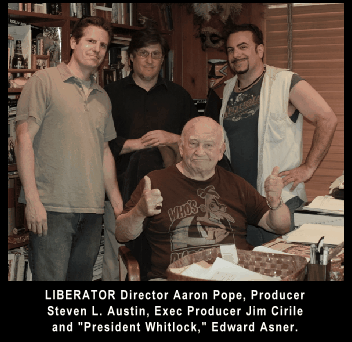
Here's the thing. As screenwriters, we are all taught that once we finish the script, we are powerless. We must depend on others -- agents, managers, producers, etc. -- to champion or produce our scripts. Well, f*** that! Time to take back the power, brothers and sisters. Our day has come. Advances in tech have made it possible to shoot a great-looking movie on your iPhone, for crying out loud. Anyone can edit using free software that comes with your computer. So why are we sitting around whining about not being able to find an agent? Who the hell needs them -- or studios, for that matter, anymore? Okay, so maybe you can't afford Brangelina or Industrial Light and Cheesy Overdone Computer Graphics. But you can sure as hell afford that great gal you saw in the Pippin revival last month and your neighbor's son who's studying VFX at Lower Botswana Community College. And hell, we were able to get four actors who starred in hit television shows for LIBERATOR -- Lou Ferrigno (The Incredible Hulk,) Peta Wilson (La Femme Nikita,) Michael Dorn (Star Trek: The Next Generation) and the legendary Ed Freakin' Asner (Up) for our movie. Okay, yes we had to dig a bit deep to get these guys, but not as deeply as you might think, because the script lured them all in. And while having a small cast and minimal locations definitely helps keep costs down, we were able to shoot at a real-life studio downtown with standing sets for 6 days for under $5 grand, and we got a green screen stage at a local high school for free. As a result, our movie looks like a million bucks.
 |
| Jessica Jade Andres in LIBERATOR |
So, ready to take back the power yet?
+++
As always, way too much going on right now. We've got the final final final deadline of Writers on the Storm midnight Sunday 8/21 (or 12:01 AM Monday Morning) plus an amazing two-for-one team-up with the We Shoot the Winner contest. We've got the last WOTS raffle winners. We've got an interview with screenwriting guru Barri Evins, who is coming to a city near you with her her kick-ass Big Ideas seminar. And as always, we've got news, tips, and attitude in what will hopefully be a great excuse for you to procrastinate from actual writing that you won't feel too guilty about, because reading this is kinda sorta writing-related.
Onward and downward!
Jim Cirile
www.coverageink.com
writerstorm.com
 Like us on Facebook!
 +++
2)
 |
| We Shoot the Winner's Chris Soth |
And why do we like We Shoot the Winner? Because they are the ONLY contest that offers this prize: they will produce the winning script. See, this ties right back into the DIY theme in Jim's opening letter. Of course, the entry fee is higher than a regular contest, but the trade-off is you have MUCH less competition. Their regular entry fee is $297, but they're also discounting that $50 just for CI Newsletter readers. So for $247 you get both WSTW and WOTS, and that, folks, is what we call a deal. Click HERE to enter We Shoot the Winner and get your complimentary entry into Writers on the Storm -- with a $10K grand prize and 150 participating companies. Bang-zoom double-whammo! Hurry -- ends midnight 8/21.
But hey, if you cannot afford to enter both contests, then enter Writers on the Storm now at Without a Box. Final deadline remains midnight 8/21. There will be no more extensions.

So, a shout out to our current Writers on the Storm 2011 quarterfinalists to date:
- Getaway, Inc by Andy Maycock
- Sliding Into Home by Rich Sheehy
- Khamseen by AJ Ashby
- Flipping the Bird by Robert Hestand
- Just Being Jack by Judith Dunn
- O Golden Boy by John Bain
- Requited by Bill Johnston
- Hollow by Jeffrey Wagner
- Spoiled Rotten by Cynthia Sieber
- Entangoed by Cecelie Berry
- Snake Hill by Lizbeth Finn-Arnold & Sandra Longo
- Reality Principle by David Sartof
- Misfortune Cookie by Amanda Darling
- Golden Hour by Norman Wexler
- Needle's Eye by Kathryn S. Moller
- Avenging Blood by John Collins
- Triumph by John Winn Miller
But that doesn't mean she's won it, folks. Far from it! The field is still wide open. So, everyone, remember you have until midnight 8/21 to resubmit a polish draft to the contest (if you so desire) at our Without a Box page. BRING IT.

WOTS RAFFLE WINNERS. We've been giving away two free contest entries into Writers on the Storm every month since launch. So congrats to our final two winners: Cole Stennis and Emily Shostak. We've already contacted them both with instructions on how to submit their scripts. Nice going, you two! That's it for the freebies for now, but next month we will have a killer Fall Spec Season coverage SALE.
 INKTIP PITCH and NETWORKING SUMMIT NON-REVIEW. Mea culpa time. The good folks at InkTip.com invited us to their pitching event back in July. They were proud that they'd made many improvements since last year's event and were eager to get us back, since we'd previously reviewed the first Pitch Summit for Script magazine back in January. They even asked us if we could helped them set up, which we of course said we'd be happy to do, especially since they were offering us a table. So we rolled into the Burbank Marriott that Saturday at 5PM... and found them packing up. The event was over. What the hell? Yeah, see we kind of assumed their 2-day event was Saturday and Sunday, with the classes on Saturday and the pitching on Sunday, rather like Great American Pitchfest. Well, you know what they say about when you assume. Turns out the classes were on Friday and the pitching was... yeah, you guessed it. So we totally blew it. Sorry, InkTip! So if any of you guys attended the event and want to let us know your thoughts, go ahead and comment here at the end of the newsletter or else email us at coverageink@gmail.com. Now on to Golden Pitch at the Expo, which we're pretty sure starts at 2 AM on a Tuesday night...

DIY IN ACTION. Ted Leib was one of the Genre Prize winners (horror/thriller) in this year's Cyberspace Open. Though his scene "Square One" did not advance to the top three to get filmed, he did what we've been advising all of you guys to do -- he went out and shot his damn scene anyway (hey, do we detect a theme building here?) Ted sent us the link with this note: "I shot the genre prize winner with a teacher and student I work with at the Orange County High School of the Arts. I think it came out nicely. Would you have any interest in putting a link to it in your newsletter?" Why, yes we would, Ted, and nice job! Check out Ted's scene on You Tube right here.


Um... so is this Superman, or Aquaman? Because his costume seems to have taken on some sort of rubbery scales. Perhaps in the reboot, Superman comes from Atlantis and rides a seahorse? Hmm. Well, this is the trend in superhero designs lately -- unnecessary texture. The costume for the Spider-Man reboot seems to have been designed by Spalding. Seriously, the bloody thing looks like it's made out of basketballs. In related news, Sony just realized that their new Spider-Man, Andrew Garfield, is 27, so they've fired him from the sequel and will reboot the series again next year with yet another origin story starring the kid who plays Brick on "The Middle."
 CYBERSPACE OPEN 2011 WINNERS! ER... NOT YET. Crap. Well, we'd hoped to bring you the winners of the Cyberspace Open, but as of press time, Creative Screenwriting was not ready to announce them. Voting closed July 31, but you can still watch the final three scenes (written by Michael Hedrick, Elisa Graybill and William Shank) right here. CS tells us they should be announcing the winners shortly, so sit tight, folks...
 WAY TO GO, RICK! Big hat-tip to our pal Rick Jaffa, who with his writing partner Amanda Silver created "Caesar," which later became this summer's best Hollywood movie, "Rise of the Planet of the Apes." I first spoke to Rick for my article skewering the incredibly faulty WGA arbitration process for Script magazine last year. At that time, he told me a little bit about "Caesar" off the record, and expressed his hope that the movie was going to come out well, since everything seemed to be rolling along smoothly. As a big fan of the Apes series, it is awesome to see a fellow fan do the franchise justice, especially after the latest abortive attempt by a certain director with the initials TB. Hail Caesar!
+++
3)

WHO is your movie about? Use the first ten pages of your screenplay to SHOW us. It's called "establishing your protagonist in his/her known world."
After the "hook," which is a visual scene that sets the tone for movie (pages 1-3,) spend the next 7 pages leading up to the catalyst, AKA the inciting incident, showing your protagonist in their day to day life.
Many writers make the mistake of launching the story right away. While some movies have done this effectively, more often than not this approach means you have to find other, clunkier ways, to inform us as to who the protagonist is -- such as flashbacks, voice-over and (ugh) expository dialogue like this:
GUNTER
Say, Bill, remember when you foiled that cheese
factory robbery last year? Because you're a police
officer? And you fell in that vat of Velveeta? But
that's okay because I know you like spray cheese
and also zydeco music and you collect belly button
lint, right?
that's okay because I know you like spray cheese
and also zydeco music and you collect belly button
lint, right?
So don't be afraid to use those pages to depict character. Make your lead(s) as dimensional and fascinating as you can. Show us their world, their friends, family. Go home with them and show us (don't TELL us) how they live. And THEN launch into the story and screw everything up for them. Go fer it!
+++
4) BARRI BRINGS THE BIG, BIG IDEAS
By Jim Cirile
We met former development exec and President of Debra Hill Productions Barri Evins at Great American Pitchfest in June, and we found her immediately impressive. A lovely and charming woman who comes from the bigs (and quite clearly knows her stuff,) she is a ball of energy and positivism. In addition, she works tirelessly on charitable causes, not the least of which is the amazing First Book, which has donated over 80 million books to needy children. Whoa!
Barri's coming to Boston September 30th with her Big Ideas Weekend Intensive Seminar, so we thought we'd let her tell you guys all about it.

Barri Evins: I am a working film producer working on some fantastic projects, and in addition I am a screenwriting teacher. My whole goal is to help new writers by giving them the same sure-fire techniques that I use with professional writers.
JC: Okay, before we go into that, tell us a little more about the producing side. Are you actively developing projects now?
BE: My focus right now is on developing my own projects. I have a passion project, a true story called Stetson Kennedy with Tobey Maguire attached to produce and star in it, and it has Academy Award nominated screenwriters Mark Fergus and Hawk Otsby, who wrote Children of Men and Iron Man are attached to write the script. That is my passion project, my big, big boulder that I am pushing uphill. It's a character-driven dramatic thriller in the vein of Donnie Brascoe meets No Way Out. It's the story of a man who grew up in a rich, white Southern family. He was very idealistic, and when (World War II) came along, everyone signed up. But he was 4F -- he couldn't enroll. He decided he needed to do something important. So he moved to Atlanta, Georgia, pretended to be a racist and proceeded to infiltrate and expose the Klan from the inside out.
JC: Wow, that is a killer story. I would imagine your experiences in the trenches have informed your approach to teaching?
BE: Absolutely. In my work with Mark and Hawk, they talk about how professional writers never get writer's block. The very same techniques that we used to develop a very imporant pitch to lots of very important people are the same techniques I share with writers who I meet with. We also had to take a true story and craft it quickly and efficiently into a really compelling theatrical story that would sell. We had to do it expeditiously, because these writers make a great deal of money. This is how it works in the real world. A lot of aspiring writers get caught up in what a lot of really smart screenwriting gurus have to say, but each of them talks their own talk and have invented their own vocabulary. That's why we break it down and show people that all of these brilliant guys from Aristotle on are saying the same thing about story. We talk in the same language that you hear in Hollywood industry meetings, which is about the five big beats and how to think that way and how to structure the script coming out of that -- as well as how to create strong stories and especially on how to focus on the very truth of the idea -- everything begins with the concept. It's a really organic way of looking at it.
JC: Give us the heads-up about your seminar.

JC: Wow. So what does that entail?
BE: E-mail and phone calls. People send me their one-pagers. They get feedback. Then I really prefer to have phone conversations, so that we can have an interaction. The part of my job that I love is the interaction with writers and development.
JC: Suppose someone comes in with a screenplay they want to workshop?
BE: This seminar is geared towards brand-new ideas. People are welcome to contact me for a script consult, and I'm really renowned as being the pitch doctor. But this is geared towards developing new ideas based on your terms, your passion, as well as an understanding of the marketplace.
JC: This is a two-day event?
BE: It is two days and two nights. When I say intensive, I mean intensive. We actually bring in all the food and drink. It's like a casino -- we don't let you leave. We create an intimate atmosphere, and it's Friday night, all day Saturday; there's a screening on Saturday night, and then we go all day Sunday, and they have to (participate in) my very unique idea-generating game. I dig deep, and our work on the seminar actually begins in advance with different exercises designed specifically to help me give everybody a truly transformational event.
JC: Fantastic. So how can people get in on this? You're coming to Boston next, yes?
BE: Yes. I go all around the country. I've taught in Richmond, Virginia, Chicago, San Francisco and Cleveland, and the next seminar is September 30 to October 2nd in Boston. That seminar is half full already. So anyone who wants to attend, contact me at signup@bigbigideas.com. There's a discount to the organizer of writing groups and nonprofits (contact Barri for details.) And since I am a mentor for Cinestory, there is also a Cinestory discount, which is part discount and part donation to Cinestory. If you say "WOTS" when you sign up, you'll get a 10% discount.
JC: Excellent, thanks for that -- WOTS for Writers on the Storm of course. I want to also mention your nonprofit pursuits. I love what you're doing with First Book, and I understand even the seminar has a "giving back" philosophy beyond simply teaching.
BE: Absolutely, and thank you. I try to enhance every community that I visit, so I most often, if I can, pair a seminar with a free screening for the public or a local writing nonprofit. It really is a great way of giving back, and I often partner with a film commission and/or a local university.
JC: Thanks so much for your time, Barri. Any closing thoughts?
BE: You can got to my web page or my Facebook page or my YouTube page and see terrific success stories. One of my greatest success stories ever what a concept that was developed into a treatment, which then sold for six figures in four hours to Warner Bros. This method works. My writers are moving on. They're optioning books, they're making progress in coming up with stronger, more commercial ideas that they still feel extremely passionate about. That's why we begin with all these advanced assignments, so that I can help writers target their passion and their strengths.
+++
5) MO’ MONEY, MO’ PROBLEMS
Every up and coming writer dreams of breaking in. But what then? Here’s how to keep from going broke as a successful writer.
Reprinted courtesy of Script magazine
By Jim Cirile
Ah, the life of the Hollywood screenwriter – fame! Fortune! Okay, not so much fame. But still – fortune! Right? Heck, your spec script could sell for a million dollars. Unlikely, but it could happen. You could become a production polish guru netting $250,000/week. Unlikely, but it could happen. Or you could sell your script for WGA scale plus 10%, then melt down into a neurotic mess for the next ten months until the next check, any check, finally comes in.
Likely, but it could happen.
Welcome to the scintillating world of Mo’ Money, Mo’ Problems (with apologies to Notorious BIG.) We’re serving up the good, the bad and the ugly of how the whole money thing works for successful writers. We’re not even going to talk about being an up and comer, since as we all know, your writing income during that time is called “day job.” There’s no shame in that, and in fact it’s part of the deal, so suck it up -- and I said extra whipped cream in my Java Chip Frappucino, thanks. But once you finally do claw, scratch and furrow through the reinforced battlements surrounding Hollywood, it’s a good idea to have a clue what to expect.
THE PEOPLE WHO TAKE YOUR MONEY
Let’s say you sell your spec script for a cool $100,000. Nice, right? But how much of that do you actually pocket? The answer is $425.32. Okay, okay – kidding. But not as much as you may think. Tere are a lot of people with their hand out – agent, manager, attorney, WGA. And don’t forget least everyone’s favorite uncle (Sam) who desperately needs your money to keep blowing people up around the world. Here’s the breakdown:

Poof. Your six-figure payday is now the average salary of a llama groomer or a junior high janitor. The picture is exponentially worse if you have a writing partner. Each of you would net $22,601.25. And let’s not even discuss the 10% sales tax on anything you buy in Los Angeles. Oh, did I mention the $2,500 WGA West initiation fee (mandatory with any deal with a signatory)?
Uh... okay, that pretty much sucks. I know what you’re thinking – who needs all those hangers-on? Well, you do.
AGENT – It’s possible to get a deal without an agent, to be sure. They generally do next to nothing until you’re already established anyway, and then after you’ve done all the heavy lifting yourself, then they come aboard. You may be able to roll with just a manager and an attorney, especially if your manager is a former agent and has solid connex in town. But managers cannot legally negotiate for you, whereas agents can (or a manager/attorney combination could save you big bucks.) But when you’re starting out, the more people you have on your team, the better. Agents come with relationships, and those can be key not only to launching your career, but also introducing you to the town.
MANAGER – You don’t necessarily need both an agent and a manager. But what’s also true is that generally speaking, agents won’t give you the time of day, whereas managers will take your calls and help you develop your script until it’s good enough to land the agent who will then likely ignore you in the first place. If by some miracle you score an agent without a manager’s assistance, you’re either extremely lucky or your college roommate just happens to work at WME. But even in this scenario, you’re likely destined to be just a name on an 80-person list the agent can’t really bother with. Managers exist to provide that handholding and development most of us actually need but don’t think we do, to get us ready for prime-time as well as eventually get us the agent. So yeah, you don’t need to shell out that extra ten percent. Except you kind of do.
ATTORNEY – Five percent for an attorney? Trust me, that’s a deal. What can an attorney do for you that an agent can’t? A lot. They can build in bonuses and protections into your deal that agents sometimes miss or can’t be bothered with. If you get a piece of the merchandising of your film as well as box office performance bonuses, it’s because your attorney went to the mat for those. He is your “bad cop.” You certainly don’t want to be a d-y-c-k to the company who bought your project, and your agent may not want to ruffle too many feathers there either. But lawyers have no compunctions about ripping into the rapacious studio business affairs guys (whose job it is to screw you and delay payment in every possible way.) They act as your pit bull. You can certainly do a deal without an attorney, but you’ll likely get bent over most majestically.
So what's a working writer to do? Make as much money as possible while you can, obviously. The better the work you do, the more you’ll make. And if your quote is $250K and you’re getting two of three gigs a year, heck, even with everyone’s hand in your pocket, you’ll make out pretty well. So now the main thing is to try not to sabotage yourself, and to learn to financially cover your ass.
SUSTAINABILITY
Many of us are assume that once we’re in, we’re golden. Er, not so much. ICM agent Emile Gladstone says the average life of a screenwriter in the biz is about five years. There are factors both within and out of your control that conspire to railroad your career. First up: ego. Think you can keep your mouth shut when idiot producers make you rewrite your draft (uncompensated) for the 26th time? Can you suck it up and say, “Thank you, sir, may I have another?” Because it is exactly that ability that defines the successful writer with a long career. Seems obvious, right? But when you are in the thick of it and can’t take it anymore, you will rationalize a teeny little outburst. And in one fell swoop you could kill your career – no one wants to work with anyone perceived to be “difficult.”
And beware the trap so many writers fall into – not writing. We harangue our reps to keep shopping material the entire town has already passed on. Many a career has been killed by writers simply failing to write.

Sooner or later, the gravy train will derail. You need to have a strategy for how to handle that.
DIVERSIFICATION
Okay, you’ve banked a couple hundred grand and are working steadily. What you need to do now is grab the snazziest suite in the Bellagio to celebrate your success and cruise in there in your smokin’ new Bentley Arnage. Buy an expensive house in Pacific Palisades with a heated pool and hire a staff. Take your pals to expensive dinners... in France. Oh, my God, did any of you believe any of that? Surest way to disaster. Many a writer has done exactly these things, only to wind up a one-bedroom in Van Nuys in short order.
So: diversify. Sure, we’re talking saving and investing, but that’s just part of it. Sock money away in the best interest-rate accounts you can find. Invest, but beware the volatile market – many of us lost good chunks of our life savings in the past few years. But also think about developing secondary and tertiary revenue streams. In other words, develop ways to make money immune to the vicissitudes of the movie business.
Maybe there’s an investment property you can buy – land, or perhaps an apartment building where the rents cover the mortgage every month and you make a little profit on top. Maybe you’re a closet cake boss. You could open a bakery and hire a manager to run it for you. Perhaps you can partner in your cousin Aloysius’s start-up electric dog polishing service. Because when your writing career gets cold, it’s nice to know Barky’s Wash & Wax will cover your rent! We all have interests other than writing – baseball, renaissance faires, study of ancient Latvian dentistry manuals. Find a way to monetize it. Putting all your eggs in the screenwriting basket is the surest way to eventually crush a marriage and land you in therapy (which you will not be able to afford.) Please consult with a trusted investment professional before investing in anything. We at Script magazine are not financial advisors and are not making specific recommendations.
IF ALL ELSE FAILS
So now you’ve seen that despite your best efforts, despite years of dedication to the craft, your exciting new career may end sooner than you thought. What to do when that happens? Go to ground and plot your comeback. Take the time. Maybe it’s six months. Maybe it’s two years. Your next salvo is going to be incredibly important. It could reinvigorate – or permanently sink – your career. And then, when you are absolutely certain that new piece of material is tight enough to bounce quarters off of, then contact your remaining industry pals and casually ask them if they’ll check out your new spec. The great thing about being a writer is that a sizzlin’ new spec can re-energize even the iciest career.
And remember, there are plenty of ways to be a writer. Consider TV, novels, childrens’ entertainment, plays, etc. Bang out a 5-page comedy sketch and put it up on YouTube or Funny or Die. Something you could generate in a weekend could wind up going viral. Same principle – shoot a short and take it on the festival circuit. Win a couple awards and suddenly it’s a whole new ballgame. Travel magazines are always looking for writers and pay damn well. Dash off some articles and submit ‘em. Write about that expensive dinner you flew your buddies to in France. And hey, there is no shame in falling back on that barista gig.
The good news is it has never been easier to jump-start a flagging career if you’re smart about it. Just make sure you’re realistic about what to expect from the movie business, and remember: downtown Culver City does need a pizza joint.

+++
6)

Yep, we stole the name of our letters column from "Cracked."
Dave writes: Hi Jim, thank you very much for sending me your Spec Format and Style Guide. I've just been reading through it and the layout is very clear, and you explain issues with spec script writing that isn't covered in The Screenwriter's Bible -- well, certainly not the version 4.0 copy I have, maybe in version 5.0, don't know. However, your e-book is certainly much easier to use and apply for my writing than having to refer to a large book like The Screenwriter's Bible every time I just want to check on the correct formatting to use. Your e-book and the information it contains is literally at my fingertips. Thank you for taking the time to produce such an amazing source of information for us screenwriters.
Jim C. replies: Thanks, Dave! yeah, we've been thinking of raising the price. you know, $3.95 is really dirt-cheap, and I put a lot of hours into writing that thing. How much does the Screenwriter's Bible go for? Whoa, seriously? No way can we charge that much. Eh, well forget that. $3.95 it stays!
Marcy writes: I am so frustrated with Final Draft. Why do they have to make it so hard to find the title page? Why isn't the thing simply the first page on your screenplay, and then you fill it out and continue? Why is it a separate document? How do they expect people to find it? And then when you do find it, don't make the mistake of 'saving' it! Oh no, because that gives saves your title page separately from the rest of the script. The only way to get it to save onto the rest of the script is by X'ing out of the title page, and then you save the script, and then then when you make a PDF there it is. I mean, does this make sense to anyone?
Jim C. replies: Yeah, I wrote about this in our Spec Format and Style Guide. Not sure if this problem persists in version 8, but it is pretty annoying, and probably 25% of Coverage Ink clients send in their scripts with no title page because they can't figure it out. Sigh.
+++
Thanks for reading! Questions? Comments? Shoot us an e-mail at info@coverageink.com.
You have received this mail because you are either a Coverage, Ink client, a Writers on the Storm contestant or you have participated in the Cyberspace Open Writing Tournament. We do not wish to spam anybody! And we will never sell your name to a list.
If you have received this e-mail in error, or do not wish to receive e-mails from us, please REPLY to this mail and enter DELETE in the subject line -- and we’ll make sure you’re removed immediately.
All content is copyright 2011 by Coverage, Ink.
Subscribe to:
Posts (Atom)