Friday, February 17, 2012

(MORE) TEST YOUR SCREENWRITING IQ

by
Steve Kaire

Ready for another round of 20 Questions with the High Concept King? Steve Kaire once again tests your mettle. 15 or better correct is a great score!

True or False:

1) You should always take a journal with you to every pitch meeting.

True. Record the date, name of the company and what projects you pitched to them as well as their reactions.

2) With enough practice, you should be able to pitch any story of yours in one sentence.

True.

3) If you sell a spec script, proceeds go into your Writers Guild Health and Pension fund.

False. Only contracted sales, not spec sales, go into both funds.

4) Writers who pitch well are able to sell projects the first time they pitch to a company even if they’ve never pitched to them before.

That’s false. It’s rare to sell anything the first time you pitch to a company.

5) Get the names of assistants and secretaries of companies you’re pitching to.

True. Be polite and friendly to them so they’ll put you through to their boss.

6) When you contact people you want to be in business with, be persistent but not annoying.

True.

7) Every company has an agenda that a writer coming in to pitch isn’t aware of.

True. There are certain types of projects they are staying away from but you won’t know what they are.

8) There is more theft of material in the film business rather than in TV.

False. The opposite is true.

9) Before any pitch meeting, call and find out exactly what kind of material they’re currently looking for.

True.

10) Being a successful screenwriter is more about how good a writer you are rather than anything else.

False. Your talent is important, but so are your connections to the people who can get projects sold and produced.


11) High concept scripts sell for more money than non-high concept scripts.

True.

12) Bringing in a poster of your movie won’t help sell it.

False. When pitching, having your potential buyer visualize the movie poster can help in fostering a sale. But beware: that poster better be of professional quality or there may quickly be a smoldering, self-inflicted bullet wound in your foot.

13) Showcasing your short films on YouTube won’t help your screenwriting career.

False. Anything that gets your work and name out there can help.

14) Produced film and TV scripts can be purchased online.

That’s true. You can also find them for free on sites like Drew's Script-O-Rama.

15) Below-the-line refers to behind-the-scenes talent.

True.

16) There is a limit on how many writers can be brought in to rewrite a sold script.

False. The studio can bring in as many writers as they want. There is a limit to how many writers the WGA will allow to share credit, however.

17) Most new TV series begin with a proposal, a list of characters and six story line episodes.

True.

18) Associate Producer credit is essentially a throwaway credit.

True. It’s given out as a favor like to the director’s girlfriend or the producer’s brother-in-law.

19) The average film budget is $75 million these days.

False. It’s closer to $40-50 million.

20) A star who lends his or her to a project is contractually bound to appear in it should it get made.

That’s false. They can back out before the deal closes.

+++

How did you all do? If you got every one right, then pat yourself on the back and go get 'em, tiger. If you knew several, then way to go! If many of thesed stumped you, definitely start reading the trades regularly. Becoming a savvy student of the biz is key to making it as a writer in TV or film. Keep up the good work, and I'll see you all back here in 30.

Steve Kaire (HighConceptScreenwriting.com) is a Screenwriter/Pitchman who’s sold 8 projects to the major studios without representation. His top-rated CD, “High Concept--How to Create, Pitch and Sell to Hollywood” is available on his website along with original articles and national screenwriting contests.

Back to newsletter

10 Things Your Agent Will Never Tell You


Think your rep is giving you the real skinny? Maybe not. There are certain secrets they will never divulge to the likes of you. Let’s pull back the curtains, shall we?

by Jim Cirile

Agents and managers by definition are wheeler-dealers. So don’t expect a lot of honesty from them, right? You’d be surprised. Our panel floored us with their candor. When it comes to dealing with clients, many have decided it’s easier to just be honest -- so as to avoid the “Which Lie Did I Tell?” syndrome, to paraphrase Bill Goldman.

That said, don’t ever assume you’re getting the whole truth and nothing but the truth. There are things that even the most forthright representatives may be reticent to tell you. Thus, with our panelists speaking under condition of anonymity, we proudly pull back the curtain to bring to you the cold, hard truth. Ten things your agent or manager will never tell you, comin’ at ya right now…

10) Your script blows. This is the obvious one, so we’ll get it out of the way first. There are a couple of different scenarios here. If you’ve finagled a submission into an agency or management company, you are no doubt familiar with the “Thanks, but it’s not what we’re looking for at this time” response. “You really want to keep (passes) as generic, as vague as possible,” says Agent A, veteran of one of the big 3-letter agencies. “You don’t want the writer whose script sucks to perceive any sort of opening.” In other words, provide any details about why they’re really passing, that opens the door to conversation (or argument.) ‘Not what we’re looking for at this time’ is non-judgmental and shuts down most writer responses.

However, the picture changes a little bit if you’re a client. If your new script bites it big-time, it’s in everyone’s best interest to convey to the writer at least a version of the truth. “I might say, I was really excited to read it, and as you know, I’m always looking for something that I can rally behind,” says Agent A, “but I didn’t respond to it the way I was hoping to. Sometimes the writers will accept that and try to fix it or move on to something else, but other times they’ll insist you do something with it.” In those circumstances, Agent A might send the script to a few industry friends, wait for the inevitable third-party confirmation of the script’s asstasticness, then delicately pass that along to the writer. “I’m not always right, and there have been times I’ve been surprised,” says A. “But if I’m right, I’m right. If (the writer) gets it then, great. If they don’t, we’re going to have a problem.”

9) How the Hell Am I Supposed To Sell This Thing? Look at what’s playing at the local 32-plex. Can you see your movie alongside those others up there? Agents and managers earn their daily bread by being keen judges of the market. If you give them some quirky experimental script that could never sell in a quintillion years, they may honestly want to throttle you. “Generally we know if advance what they’re working on,” says Manager B, from a well-known boutique management company. “But there have been times when a client drops this lead sinker on us and expects us to do something with it.” Now this doesn’t necessarily mean the script isn’t any good. It could be great, just a tough sell. “Let’s say someone has a period drama -- I don’t even want to read it,” says B. God forbid the rep actually loves the script. That puts them in the awkward position of having to mount a quixotic, time-consuming and likely doomed mission to sell it. “I did have this one drama once; it was amazing. I had to make it happen,” B enthuses. “It took over a year but I finally got it set up (at a small production company.) An amazing, rewarding experience I’m not in a big hurry to repeat,” she laughs.

Manager C, however, uses the picky marketplace as an easy way to pass. “I just say, I don’t think this is something the market will respond to right now, and that’s that.” And if the writer pushes it, “I have to tell them, look, I think if I do send this out, ultimately it will be detrimental to your career. You don’t like saying that, but sometimes you have to.”


8) Never Read It. Never Will. When you submit a script to an agency or management company, do you think the rep actually reads it? Ha! At smaller firms, it will often be covered (read) by an assistant or intern; bigger firms also use freelance or in-house readers to provide coverage. I have been in meetings where it is clear my agent had not read the script and had to keep referring back to the coverage. Even if you’re a signed client, there are some reps who simply never read. “It’s pretty well-known in town who reads and who doesn’t,” says Manager D. “Some guys actually brag that they can sell a script without even reading it.”

But we’ve got a good panel here – they read. “Sometimes my clients try to catch me,” says D. They’ll name a character after me in the third act or something. I always make it a point of mentioning that I caught it.” Still, it goes without saying that if it’s a pass, it’s more often than not based on the assistant or the intern’s coverage report. So when does an agent actually read a (non-client’s) script? “I trust my assistant, but she had to work hard to earn that trust,” notes Agent E from a mid-sized agency. “It took a while for her get to the point where I am 100% confident in her opinions. So when she tells me to read something, I know it’s worth my time.”

7) He’s Just Not That Into You (Anymore.) It’s sad, but like any relationship, you and your agent or manager may someday fall out of love. How do some reps deal with this? Why, radio silence, of course! “Those are the calls you dread making,” says Agent A. “It’s no fun to tell someone it’s not working out. So to be honest, yeah, sometimes I’ll just not call and hope the person eventually gets the message and starts looking for new representation.”

Of course, there are different reasons why a rep might want to end the relationship. “If it’s going on two years, and the writer hasn’t gotten any work,” notes Manager B, “but they’ve come close, I’ll hang in -- if a spec almost sold, or if they’ve gotten traction. But if there’s just nothing at all? I might say, look, maybe I’m not the best rep for you. There might be someone else out there better suited for what you do.” In other words: it’s not you, it’s me.

6) Reconsider Dad’s Plumbing Business. This is definitely the hot potato. On the one hand, as ICM’s Emile Gladstone once said, “Screenwriting is a craft -- like carpentry. It can be learned.” On the other, there are just some folks who should not be writing screenplays. “I’ve read some queries where the writer can’t even compose a sentence,” says Agent E. “It’s like, dude, what are you thinking? Buy a Subway franchise or something.” Manager B notes that if it’s been 8 or 10 years and you haven’t gotten anywhere -- no contest showings, no industry interest, no connex, nada -- “That may be a sign that you just don’t have the goods.” Still, she notes, the problem may be correctable. “It could just be the writer needs to take some classes and get some real feedback, work with someone who knows what they’re doing.” But don’t look to our panelists to actually tell you this. They won’t. “Don’t try to be a writer if you have a passion for anything else,” says B, “and don’t quit your day job.”

5) Your Neediness is Going to Cost You. We writers tend to be a fairly insecure lot. We often work alone for years on end, each 'pass' another tiny incision sucking your soul away. Suddenly, success! But all those neuroses you’ve built up don’t just evaporate. The reality is: your rep doesn’t want to deal with that crap. “I’m not a babysitter,” says Agent A. “I have a lot of clients, and those clients need to respect my time. I’m happy to talk about a project or your career or if something is going on. But if you’re calling up just to chat, or for the sixth time that week, my patience is going to run out quickly.” In short, it’s the writers who can be kickback and exude cool that reps keep around. Learn to front, and vent those neuroses to your shrink or your journal, not your agent. “How much of a pest they are, that definitely figures into the decision-making process (of whether to retain a client or not,)” says A.

4) I’m Not Going to Do As Much For You as You Think. You’ve just landed your first agent or manager -- congratulations! Now you can sit back and coast. They’ll line up meetings for you and do all the work, right? Wrong! The reality is that even with representation, you still have to market yourself. Agents are an interesting lot -- the more your career heat you have, the harder they’ll work for you. But if nothing is happening, don’t expect them to whip up a furor out of thin air. It’s up to you to fan the flames.

Oftentimes a rep will “hip-pocket” a writer-- acting as official (unsigned) representation-- in the hope that the writer will take flight or bring in deals on his own. In these cases, the rep may not do anything for you at all! We’ve all heard writers grousing on and on about their agents. There’s even that joke about the writer who comes home to catch his wife in bed with his agent, and the writer beams, “my agent came to my house!” Yeah, it has its basis in fact. “Don’t expect me to send out every script from your back catalog,” says Manager D. “Bring me great new material I can sell, and I’ll bust my ass for you. If not, eh…” Segue to…


3) Write Something, You Lazy Bastard!
“This drives me crazy,” says Manager C. “You’re supposed to be a writer. Well, let’s see some evidence of that. Don’t expect me to keep sending out the same spec a year later. Move on.” Yep, writing is hard work. Douglas Adams (“Hitchhiker’s Guide to the Galaxy”) famously said he much preferred having written to writing itself. But in Hollywood, “new” is a commodity. “I might gently urge them to get back to me with some ideas, and from there we should figure out what they should work on next,” says C. “But what I really want to say is, What is wrong with you? How do you expect to be a professional writer if you don’t write?” C calls this his biggest pet peeve and notes it’s oddly endemic in writers. “I just don’t get it,” he opines.

2) It’s Not the Team. It’s Me. Only after being reassured this was strictly anonymous, Agent F, head of lit at a medium-sized agency, hits us with a technique. “I often blame the (agency feature literary) team,” he notes. “I’ll say hey, I really wanted to make something happen with this, but I couldn’t get a consensus among the team.” Sayonara, don’t let the door hit you on the ass on the way out. F also mentions this same approach is useful when attorneys or managers call up trying to recommend someone, “and it’s some fourth-rate writer I have no interest in, or someone whose career has completely bottomed out. So even though I know it’s a pass, I’ll tell them I’m excited to read it, sure, send it in. Then a week later I call up and say, sorry, you know, the team just wasn’t as enthusiastic about it as I was.”

And finally, the number one thing a rep will never tell you:

1) Anything. A rep will never tell you anything. By that I mean, if you’ve managed to get an agent or manager to agree to read your script, a Herculean task in and of itself, you may think you’ll actually hear back from them at some point, even if only to pass. And sometimes you do (see number 10.) But more often than not, all you get is… (crickets chirping… )

Couple reasons for this. The first is time. It takes time to reply to all those submissions, and none of that time is revenue-producing. That means it rates just below toe fungus inspections on the agency or management company’s scale of importance. Second reason of course is, again, not wanting to open the door to any time-wasting back-and-forth. Simply not saying anything conveys the “no” loud and clear. But the main reason you’ll likely never hear anything back is they don’t really care. You either have a commodity they can sell or you don’t. If you don’t, next! It’s nothing personal. “I get hundreds of queries a week,” says Manager B. “I sometimes peruse them and occasionally respond to one or two. But if I sent ‘No, thank yous’ to everyone, that would literally chew up an hour or two of every day.” Concludes Agent A, “Writers have to develop a thick skin anyway to survive in the business. Radio silence is just part of the deal.”

***

Now that you’ve read this universal translator of agent/manager-speak, we hope you’ll scrutinize your own habits and the way you interact with representation now or in the future. These guys are sharing what drives them nuts and what they really mean when they tell you something. Use this intelligence well and save your career. Show your rep you know the rules of the road. They’ll love you for it. And maybe someday, you, too, can have your agent show up at your house.


Wednesday, February 01, 2012

MOVIE OUTLINE 3.1.2 Review

by Ebony Jones


The last time I reviewed Movie Outline 3, I did a comparison with two other screenwriting software packages including Final Draft and Celtx.  Final Draft is considered to be the industry-standard software while Celtx is a free (though they now offer a plus version for $9.99.)  I consider Movie Outline 3 to fall in the middle between Final Draft and Celtx depending on your budget (or lack thereof).  I have used all three and I do prefer Movie Outline. 

Recently Movie Outline 3 released a new version called Movie Outline 3.1.2.  The upgrade is free if you're currently a user of Version 3, but if you're a user of Version 1 and 2, you'll need to pay $80 to upgrade.  If you're using Versions 1 or 2, I highly recommend spending the money for the upgrade. 

Version 3.1.2 fixes some of those little quirks that tend to slow you down in the writing process like adding auto-convert and auto-capitalization.  They've also added more seamless functions if you're coordinating a script with a writing partner that happens to be an international user.  And if your British friends are driving you nuts sending you scripts that replace the “z” with an “s”, you have the option to ignore UK spelling variations.  All in all, a lot of little grammatical glitches have been fixed in version 3.1.2.

Movie Outline now offers the option to register and submit your script for copyright protection through their software.  I can not tell you how many writers don't even bother to remember how important it is to protect their scripts.  You don't need to be militant about it, but before too many eyes start checking out your hard work, make sure your script is protected. 

I have been using Movie Outline 3 for a current script project for a genre that's unfamiliar to me.  And the feature that has really helped is the Drag and; Drop scenes/steps along with the FeelFactor Story Analysis Graph.  It helps me with pacing and it gives me a clear picture of how many scenes I should have in my script.  So if I know I need 43 scenes, I can do a better job of structuring my first draft.  And I feel like it cuts out how many drafts and how much genre research that I need to do.  And these features are unique to Movie Outline.  They've given me confidence with this script that I would not have had without it.

While there are many other improvements to this software, the feature that will appeal to friends of mine that are in a screenwriting software war is the Final Draft import/export function.  This is such an overdue function.  It's like the Mac vs. PC war amongst my screenwriting friends.  One sect prefers Final Draft while the other prefers Movie Outline and neither side is conceding.  So this solves a lot of problems and keeps everyone in their software comfort zones.  Import options have also improved to include PDF, Rich Text, and Plain Text WITH LAYOUT.  Why am I yelling?  Who wants to fuss with the layout of an imported script?  I don't.  So Bravo to Magic Outline 3.1.2 for that addition.  And yes Movie Outline is 100% Windows 7 and Snow Leopard compatible.  See?  We all can get along.  That's why we creative types are so awesome.

Ebony Jones is a 2001 graduate of Cornell University's School of Hospitality with a degree in business communications.  She has completed her first unpublished novel Sierra Phillips: Swimming in Blue Liqueur as well as a short story, When Ariel Lost Her Voice. She has finally tackled restructuring the dramatic screenplay she's been working on that has now gone from When Momma Dies to untitled since the mother no longer dies.

Monday, January 23, 2012

Agent's Hot Sheet E-Book coming soon


For ten years, I had the pleasure of writing the Agent's Hot Sheet column for Creative Screenwriting magazine. As most of you know by now, sadly, CS is no longer being published. But those 60 columns represent an awful lot of crucial intelligence for writers. The top agents and managers in the biz, telling you directly how to get their attention -- that's priceless, and believe me, as a writer myself, no one appreciated it more than me. It's not an exaggeration to say that in a way, I graduated a decade-long master's program in the biz. I am honored to have been able to bring Agent's Hot Sheet to you all.

So what to do with all that knowledge? Why, put a bow on it and put it back out there, of course. Agent's Hot Sheet: Ten Years of Screenwriting Wisdom from Hollywood's Top Reps is coming to Kindle, iTunes, Nook, as well as available as a direct download from CI as a PDF. We'll let you know as soon as its available.

--Jim C.

Monday, January 16, 2012

Jason Reitman Makes The Same Movie Twice In a Row

(Or, Character Arc, Shmaracter Arc.)

Warning - Spoiler Alert!

Charlize Theron as Mavis Gary in "Young Adult"
I had the chance to check out Young Adult the other night, and I was mostly pleased. The movie was solidly entertaining, with a strong performance from Charlize Theron as a 37-year-old teen fiction ghost writer (think Sweet Valley High -- no coincidence that Young Adult scribe Diablo Cody is adapting that series into a feature) who drunkenly, blithely, coasts through life on looks and bullshit. Those who pegged Cody a one-trick pony after Juno, well, this movie more or less puts that to rest. She can write.

Patton Oswalt (The King of Queens) delivers an equally solid turn as a crippled nerd who uses a brutal hate crime beat-down (his high school mates mistakenly believed he was gay) decades earlier as an excuse to isolate from the world. Though his character and Charlize's never spoke in high school (despite her locker being right next to his,) they bond over booze, and he becomes the mentor/voice of reason to the resolutely self-destructive Theron. It's good chemistry. Thus when Theron returns to her hometown delusionally looking to hook up with her high school boyfriend (Patrick Wilson), despite his being happily married with a new baby, sparks, naturally, fly.

But something felt amiss. I felt like I'd recently seen this movie. I thought back on other films that were thematically similar. I recalled another film I saw not too long ago that covered similar ground. And that's when it dawned on me. Oh, yeah. Up In The Air. The director? Well, Jason Reitman. Again.

So just what do Up In The Air and Young Adult have in common?
  • Both feature a quasi-successful attractive professional whose career is on the skids. 
  • Charlize Theron's and George Clooney's characters are both loners who skate by on charm and good looks, who treat those they view as lesser as, well, lesser, and who cope with the emptiness inside by having a string of meaningless affairs. 
  • Having done this for years now, both are dissatisfied with their lives and desperate for change. 
  • Both Clooney and Theron's characters fixate on someone whom they erroneously believe can "fix" them and give them a normal life, and they put it all at risk to try to start a relationship with that person.
  • But in both cases, that person is in a committed relationship and is not interested. 
  • Both of them show up at the would-be love interest`s home, unwelcome, and are asked to leave. 
  • And most importantly (for this article anyway,) now devastated, both revert right back to their old ways again, leaving the characters driving/flying off into the sunset right smack dab where they were at the beginning of the movie, their coping mechanisms reinforced.
Up In The Air was the superior film.  The key here is that Clooney's character was more sympathetic, while Theron's was inherently unlikeable. We really hoped that Clooney could get something going with Vera Farmiga and finally settle down, and our heart kind of broke a little bit when his did. Theron, on the other hand, is kind of nuts throughout and so we're never really rooting for her; plus we can see from a million miles away that she's never going to get with the object of her affection. For my money, the way to make Young Adult work better would have been to do someone no one would have seen coming -- to have Theron's high school sweetheart abandon his happy marriage and baby and pounce at the chance to hook up again with Charlize (hell, this isn't really that much of a stretch.) Boy, the drama that would have created!

The inevitable "Charlize makes a scene" scene we see coming 27 miles away.
But the point of all this to me is, something about these types of projects speaks to director Jason Reitman. And in my opinion, it's got to be the anti-character arc of both movies. As writers, we're taught in film school and all the screenwriting books that you have to have character arc--your protagonist should undergo some sort of positive change during the course of the movie. This generally means that your hero starts out with some sort of personality flaw or problem... for example, risk-averse (Ben Stiller in Along Came Polly), chauvinistic (Mel Gibson in What Women Want), overprotective (Marlin in Finding Nemo), and of course neurotic/homophobic/supercilious/obnoxious (Jack Nicholson in As Good As It Gets). But during the course of the story, they interact with others who cause them to finally overcome their dramatic flaws and thus move from extreme to more well-rounded. Or as Nicholson would say, "You make me want to be a better man."

But in real life, people seldom arc. Obnoxious asses tend to stay obnoxious asses. Neurotic shut-ins five years later? Yep, still sitting there with the blinds drawn counting their soap bars. Of course, this is exactly why people respond so well to character arcs, because like happy endings, it's just not something we get frequently enough in reality. So along comes filmmaker Jason Reitman, who seems to be saying, "Screw character arc. It's a bullshit artifice and Homey don't play that." And you know what? Good for him. I'm glad someone is out there making successful, mainstream (indie-ish) movies that give us characters like these. Let's see movie protagonists who actually behave like real people, with all their foibles and obsessions and manias. And as writers, let's be bold and write those fascinating, dimensional and realistic fucked-up douchebags.

That said, Mr. Reitman, I think we kinda get it now, so maybe on your next film, you could kind of change up the paradigm just a wee bit.

--Jim Cirile

Saturday, December 24, 2011

Happy Holidays, Everyone

Lotsa good news/bad news this year. The good: the spec market came back with a vengeance, thereby creating vitality in the industry and making people want to read and discover new writing voices again. The bad: we lost both screenwriting magazines--Script and Creative Screenwriting--not to mention the CS Weekly, The Screenwriting Expo, the AAA and Expo contests and the Cyberspace Open. All of which kind of blows.

As we head into 2012, I'm scratching my head because my Magic 8-Ball is coming up hazy. The brave new world we're entering (or "New World Order," to quote George H.W. Bush) has no room for print magazines and newspapers; and while more people can make movies now than ever thanks to cheap filmmaking tech, meaningful distribution is harder to land than ever. On the other hand, the internet means people around the world can view your short film instantly and if enough people see it, it can create a buzz which gets you meetings and could eventually result in you getting hired. In fact, there's more opportunity out there for writers and filmmakers than ever before.

So it should be an interesting year. Hopefully the ride will be a little less bumpy, assuming we don't start any more wars. Merry Christmas, Happy Chanukah, Awesome Eid, Quirky Kwanzaa, and of course, a festive Festivus to all.

Jim C.

PS: Best example yet of why you need to use direct address commas: BIG difference between these two sentences: "Don't blow this, dude" and "Don't blow this dude." What a difference punctuation makes! Direct address commas--USE 'EM.

Friday, December 09, 2011

"SCRIPT" Magazine to Cease Hard Copy Publication (UPDATED!)

Well, this came as no surprise--Script has been for sale for over a year now, according to my source. The word is that while Script was in the black, it was not quite profitable enough for Final Draft, who wanted bigger margins. While that may seem a bit odd (since the magazine helps drive sales of their software, a modest return seems like a fair trade-off), what's done is done, and thus they sent this mail:
Dear Writers,

Final Draft, Inc. has decided to sell the publishing rights of Script Magazine to F+W Media, Inc. This has been a very difficult decision, but our focus at Final Draft, Inc. has always been and is more than ever today on developing technology and software for scriptwriters. We are focusing all of our talent on creating the best tools possible to serve our customers.

Starting today, please direct any inquiries you may have about your Script Magazine subscription to Writers Digest.

For 6 years we have enjoyed sharing Script Magazine with you. We thank you for your continued support and wish you success with your writing.

Sincerely,
Final Draft, Inc.
So what does this all mean, exactly? Is Script going to continue publishing, only now put out by the Writers Digest people (who also this year purchased the Writers Store)? As soon as I find out, I will post an update. Needless to say, after the fall of Creative Screenwriting magazine earlier this year, it would be quite a blow to the screenwriting community if we were to lose BOTH our print publications within two months of each other. While a lot of info can be found of websites, of course, there is nothing quite like being able to hold a glossy print magazine in your hands. More news as it develops.

UPDATE 12/12: We just heard from Script editor Shelly Mellott, and she said the following:
They are taking the magazine online so far as I know. Andrew (J. Schneider), the managing editor, will be moving on with them. I am staying at FD.
The translation:

Script magazine will most likely no longer be published in print.

Obviously, this is a massive double whammy to screenwriters. Only a few months ago, Creative Screenwriting magazine announced they were ceasing publication due to financial difficulties. And now, Script appears to be going online-only. In one fell swoop, we've lost the two big screenplay magazines.

Now I know many of you are probably thinking, so what? Who reads paper magazines anymore anyway? Well, I do. And while the economics have obviously made it a tough go in print, the fact is I like reading magazines. Sure, scriptmag.com is great, but online, it's just another screenwriting website, of which there are MANY (including this one right here.) Magazines are different. We save them in stacks. We look through them months or years later to find articles or ads we recall. We can read them on the john or on the subway. You cannot read a website on the subway. And while Kindles and Nooks and iPads are all wonderful gadgets, they ain't paper.

So once again, the earth has shifted under us. Certainly many of you have already stopped reading and subscribing to Creative Screenwriting and Script. The numbers clearly show it. But for the rest of us, it represents an unpleasant sea change. I'm reminded of a handwritten sign posted in the window of a Borders bookstore shortly after they went out of business. The sign read, "No public bathrooms. Try amazon.com."

--Jim C.

UPDATE #2 12/12: Just head from my pal Dana Hahn, Sales and Marketing Coordinator from Writers Store/F+W Media, and this is what she had to say:
Yes, we are discontinuing the print version, but it's in an effort to increase the amount of content we're able to put out through the website, and to offer new content in the form of live events and webinars. 

The unfortunate truth is that with the loss of Borders, and Barnes and Noble cutting back on their magazine offerings, there's not many vendors to sell magazines through any more. I'm personally bummed as well, but I'm glad that we were the ones who were able to take Script on, as I worry another company may have just bought the mag for the mailing list and let it just wither and die. 

We're going to stay true to the content offerings that Script has always provided, just sadly in another format.
Welcome to the future, my friends. And it appears that future holds a new twice-yearly event to replace the now departed Screenwriting Expo: F+W Media's Screenwriting World Conference. Read the official press release from F+W Media right here:  http://www.fwmedia.com/press-room/scriptmagazine


Thursday, December 01, 2011

Coverage Ink/Writers on the Storm Newsletter 12-11


SPECIAL HOLIDAYS AND WINNERS EDITION!
  1. JC's Opening Spiel
  2. Writers on the Storm 2011 WINNERS
  3. Welcome to Talentville -- Interview with Ben Cahan
  4. The People's Mic -- A Screenwriter's Experience with Occupy Wall Street
  5. The Screenwriter Stirkes Back -- DEAD IN THE ROOM
+++

SOMEONE NAMED DEBBIE who alleges I know who she is (it's possible, I know a half-dozen Debbies) posted a very interesting comment on our blog recently:
Wondering how does the winning script stand compared to killer scripts on Producers' desks. I read some winning scripts, mostly trash.
She brings up a real point, and I believe deserves a real answer. For contests in general, that answer is: usually not very well. This is one of those things we call "truth" that can be somewhat uncomfortable, but it is what it is. What I mean is, contests are generally designed to seek out and discover new talent. All well and good, of course. And so the average contest (and there are freaking hundreds of them out there now) probably gets anywhere from 200 to 1,000 submissions (Writers on the Storm had just over 1,000 this year. Only a handful of the big guns do much better.) So what are the odds that out of, say, 500 scripts from unknown writers, you're going to find one that's just radiant? Alas, not as good as one might hope, and certainly not consistently. The reason is, many folks who are on the come are quickly weeded out of contest contention because they get signed, or they get internships/staffed on a TV show, or they develop relationships and start writing stuff on assignment, on spec or even (gasp) for money. The cream is frequently skimmed off the top. This may be hard to believe for many of us who slave away in the trenches for years, hoping to get somewhere with our writing yet hearing only crickets chirping instead of cash registers dinging. But it's the truth -- more often than not, if you're not breaking in, it's because your craft is not quite as good as you think/hope it is (yet.)

And so to quote one of my least favorite people, unindicted war criminal Donald Rumsfeld, "You go to war with the army you got." A few years back, I asked a buddy of mine -- a key judge for a very prestigious contest -- if I could read that year's winner. Afterwards, I commented to my pal something to the effect of, "Dude, what the eff?" He sighed, knowing full well the script was not exactly the bee's knees, and said, "Believe it or not, that was the best from what we had to work with."

Of course, "killer scripts on producers' desks" is tricky metric to judge by. You all know as well as I that there are plenty of crap scripts sent out by agents and managers. The reason is, if a client insists that his or her new spec go out, then in many cases, even if though the rep may signal his concern that the script ain't ready yet, it will usually go out. It's a dice roll; they might get lucky. When I was repped at WMA back in the day, my agent at the time explained to me the concept of "good enough," which is exactly what you think it is. In other words, not every script problem needs to be licked before it hits the town (of course, this was the '90s, and standards have gotten much higher since.) It just needs to be... good enough. And even recently, I have read scripts from major agencies that sold, which honestly did not impress me all that much. On the other hand, I have read a few that just blew me the hell away and renewed my faith and love for the screenwriting craft.

Which brings us to this year's winner. I am ecstatic to report that I LOVE this year's winning script. It truly is that needle in the haystack. The winning writers exhibit smarts and voice and craft. The read is a joy. Big things are ahead for these dudes. So I would definitely put this script right up there at major agency quality. And I cannot tell you how happy I am to be able to say that. Now that's zero guarantee that the town will respond; heck, it's a damn period piece. But I'm going to do what I can to make something happen for these writers. And THAT is why we enter contests -- in the hope of finding that passionate advocate, someone to finally help us. And to everyone else, keep writing and keep learning. I'm still seeing lots of basic, basic mistakes being made out there. It is up to all of you to up your game.

+++

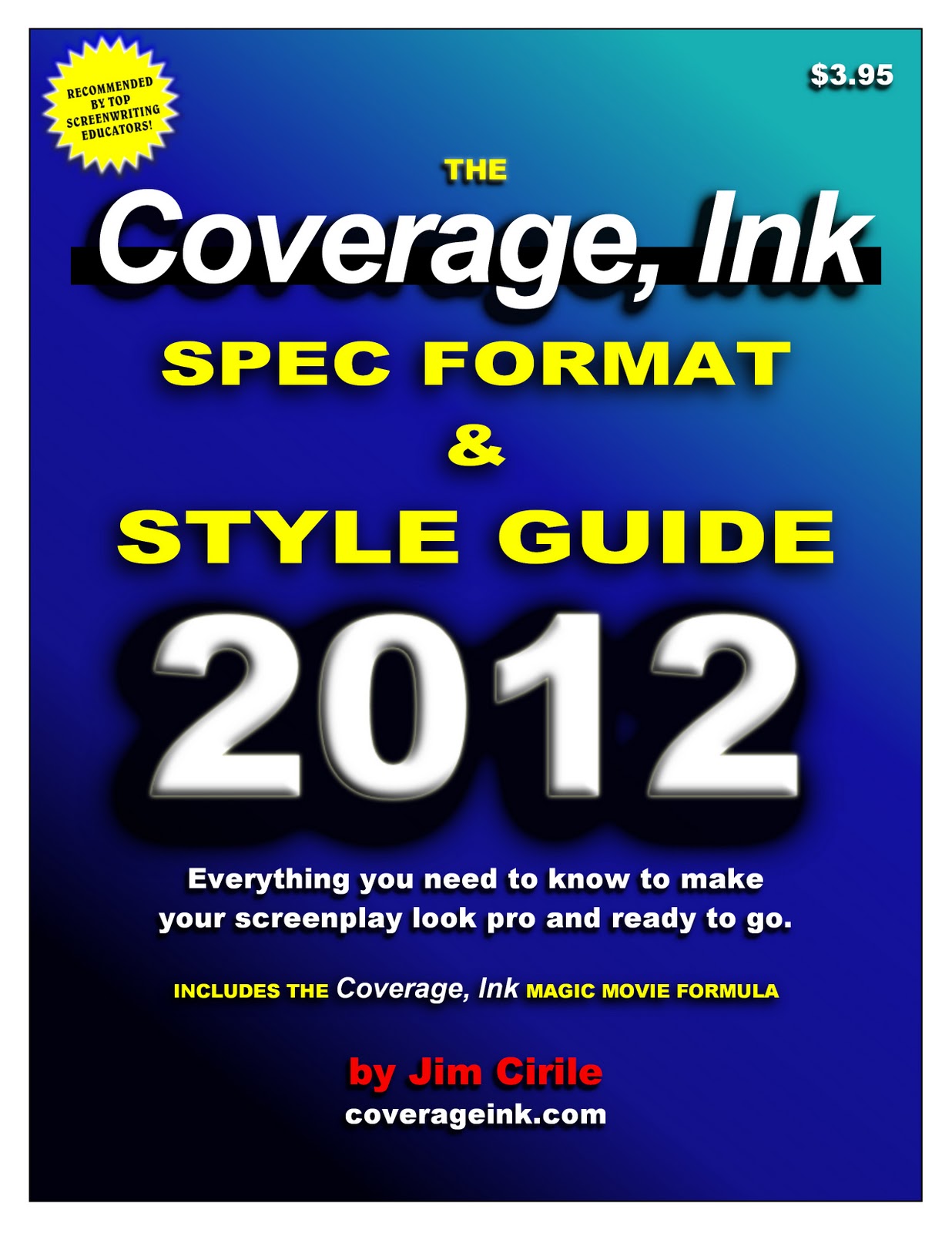
Speaking of upping your game, the Coverage Ink Spec Format & Style Guide 2012 is now available! Updated and expanded, this is the best Guide yet -- 89 pages of screenwriting expertise and snarky asides you can ingest in an hour. It's a 50,000-volt blast right to the ol' batteries. Even if you think you know all about format, this e-book may just shock you with how much you didn't know -- as well as drastically improve your craft. And if you think $3.95 is an absurdly low price to pay for such an infusion of goodness, well, you would be correct. But there it is. Order yours by emailing us at info@coverageink.com and say, "I want my Spec Format Guide 2012!" Makes a great (CHEAP) holiday gift!

And for those of you who want the ultimate holiday gift for the screenwriter in your life, get yourself a Coverage Ink gift certificate! Available in any amount from $10 up. Just imagine the look on your significant other's face when they open up a 1-hr CI telephone consultation ($45) or a fully-blown CI standard analysis ($129,) now featuring our newly expanded feedback grid. Hit us up at info@coverageink.com and get your merry on!

But enough of this jolly banter. It's newsletter time! In addition to the Writers on the Storm winners, we've got an interview with Ben Cahan from Talentville.com, an awesome new screenwriting community you should all check out (free!) Director Adam Pertofsky and writer Marjory Kaptanoglu give us the scoop on their amazing, must-see short film Dead in the Room, and firebrand screenwriter Jen Senko tells us about her experiences in the thick of it at Occupy Wall Street.

Wishing success and health to you all in this next year. Let's dial it up a notch, everyone!


Jim Cirile
founder, Coverage Ink
Writers on the Storm Screenplay Competition


 Like us on Facebook!
Follow us on Twitter!


Continue on to:


+++

WRITERS ON THE STORM 2011 WINNERS

Over 1,000 submissions, and it all comes down to this. The best of the best! The Writers on the Storm top ten. And boy, what an interesting batch it is... a creepy-cool zombie script, a hard-boiled '40s detective story with an African-American protagonist, a WWII sea battle epic, a cave collapse horror movie, a Western, a movie about a young wheelman, and even a comedy about the Wright Bros. first flight (seriously.) Talk about apples and oranges.

And yet through it all, one script clearly shone through. Our winning script is what all of us aspire to in a spec script -- a cool concept, tight execution, screenwriting "voice" clearly on display. But most of all, it's a page-turner. You're enjoying the read so much, you're compelled to keep reading. That's the sign of a winner -- a script that grabs you by the throat and doesn't let go. Doesn't matter what the genre is.

And thus it is with enormous pleasure that we annouce the WINNER of Writers on the Storm 2011:


Elms + Sanders are in the "Wright"
WINNER: WRIGHT OR WRONG by Glenn Sanders + Brooks Elms.  What a fun script! These writers have pulled off something insanely difficult -- they've written a period-piece comedy that will turn heads. This nutty, goofball script stars none other than Orville and Wilbur Wright, reimagining them as stubborn, contentious, charming dopes. The writers brilliantly set the tone on the very first page with this intro: "THE FOLLOWING FILM, WHILE BASED ON REAL EVENTS, IS A RABID PACK OF LIES." What follows is 109 pages of character-driven hilarity. When the feuding brothers finally set aside their differences and make that famous flight, your heart soars right along with them. We're very excited to be working with Glenn and Brooks. Big things are ahead for these guys. As the brothers themselves oft say in the script, Excelsior!

SECOND PLACE: A SHIP THROUGH FIRE by John Winn Miller. A crackerjack, old-school swashbuckling adventure epic about a smuggler trying to deliver his precious cargo safely while chased by a vengeful Nazi U-Boat captain. The cargo: Jews. A thrilling read and again, a page-turner, peppered with terrific, layered characterizations and literary references. The sea-going action is dynamic and the twists -- such as the beleaguered crew mutinying -- keep every page tense. The writing, too, is crisp and lean. Mr. Miller put a lot of work into this one through many drafts (we know because he's been developing this one using CI for coverage for some time!) and it has paid off big-time.

THIRD PLACE: THE BENEATH by T.J. Cimfel. What could be worse than a mine accident and realizing your husband is trapped inside? How about realizing that there may be something else down there with him? Cimfel's script is a marvel -- that rare horror/thriller where the characters are fully developed, the dialogue crackerjack. Protagonist Abby has high personal stakes and we love her go-getter attitude as she relentlessly drives the rescue mission, unaware of the horrors that await.

And while not everyone can make it to the top three, let's hear it once more for the rest of our top ten: Alison McMahan, Louise Ransil, Andy Maycock, Charles Mitri, Josh Flanagan, Alexis Lane and Travis Heerman + Jim Pinto. 

We'll be contacting all of our top ten about setting up the consultations and delivering the prizes. Now begins the development phase! What, you thought you were getting off easy? All of these scripts have coverage and consultations as part of the prize. Whether or not anyone in the industry responds to these scripts is up to how much you bring it over the next couple months. Are you going to coast on the current draft, or are you going to dig in and freaking bulletproof your material so that it hits like an atom bomb?

Thanks again to everyone who participated in Writers on the Storm this year. Needless to say, we will be back...

Jim C.

Back to Newsletter

WELCOME TO TALENTVILLE

INTERVIEW WITH BEN CAHAN


Ben Cahan has been part of the entertainment industry for years, but not in any of the typical roles we've come to associate with show business. Ben is the pioneering computer programmer who created and co-founded Final Draft screenwriting software. After leaving Final Draft, Ben decided to put on his pioneer hat yet again. His latest venture is the new online screenwriting community called Talentville, which is sort of like Trigger Street, InkTip, Zoetrope and Project: Greenlight all mashed together and topped with a shimmering bow of screenwritery goodness. We got a chance to talk to him about his ambitious plans.

Interview by Jim Cirile

Jim Cirile (JC): Thanks for chatting with us, Ben. What was the genesis of Final Draft? Did you look at what was out there and say, eh, we can do better?

Ben Cahan (BC): Before Final Draft, I wrote production software -- budgeting and scheduling software. People came to me and said, “We’re not happy with the screenwriting software out there.” Everybody wanted something better, and the tools [were] just becoming available to really integrate a word processor, and then add the intelligence to do screenwriting, all in one package. The genesis was customers.

JC: And it did become the predominant screenwriting software.

BC: It did. There was Scriptware, there was Script Thing, which I think turned into Movie Magic Screenwriter. There were a number of other products, and we squished them all. And I’m happy about that.  There’s no reason, as a businessman, to not want to be number one. 

JC:  You are no longer part of the company, correct? You and [co-founder] Marc [Madnick]  parted ways amiably?
Talentville founder Ben Cahan

BC: Absolutely, we’re still very good friends. Friends and business partners are a strange combination – the mix is not as easy as one might think.  We started as friends.  I sold out to him in 2003/2004, so it’s been a while now. After that, I did some traveling, some outdoor adventuring, and ultimately, when I decided I wanted to actually do something again, I started reading screenplays.  Many will laugh at that – the idea that I thought I could be a production executive and producer, being a software creator. Creating software for writing screenplays is not the same as producing movies. Over a six-month period, four to five years ago, maybe a little bit longer, I read about 2,000 scripts. But even though I found a few good scripts, it was too much time – it was six months to read 2,000 scripts, to find ten I liked. I realized that needed work.

JC: Sure, you need a filter.

BC: I said, there has to be a better way. I did some investigation of what resources are out there – how can this process be done better.  Having interns, sitting downstairs reading, that’s still one opinion. But you can automate the process to create a system that really can find, through crowd-sourcing -- a word I’ve come to love -- stuff that at least makes it to a certain point. The goal is not necessarily for the open community to pick the next movie that’s going to be made. Even [at] Project Greenlight, which was a great idea but a failed experiment, the real producer got involved and read the top scripts to decide. But if you have a thousand scripts, six hundred of those, from totally amateur writers, are going to have grammatical problems, they’re going to have no structure, no story, no plot, poor characterizations, bad dialogue – and that’s just because writing does take some skill. So, start with a thousand.  Six hundred can go away right away by anybody reading them -- anybody that even understands anything about screenwriting. (Then) you have to have a multi-level review system where people that are more experienced get involved, and that’s the kind of thing that I wanted to create.

Talentville's Main Street
 And that was sort of the whole idea -- how do you get the thousand down to a hundred?  I’m willing to read a hundred.  If I have a producer, for example, such as Marty Katz, one of our site advisors -- he’s got four interns downstairs reading scripts all weekend.  People sign the release, they send their script, and the interns read them.  The problem is you’ve got four people downstairs reading scripts all week. Now how about if every month I gave him a stack of ten scripts and said, these are the best.  Already been vetted.  It doesn’t mean he’s going to want to get involved with any of them, but the odds of all of them being pretty good are probably pretty high if we have an active site.

JC: Yeah, it would be great if there were a site that does what the Hollywood system does, without being the Hollywood system.

BC:  There are enough scripts out there that no company could hire enough readers to read all of them.  So the idea is - get the public involved. That’s the secret. And I will tell you why it works, by the way. It works for the same reason that Amazon.com’s book reviews work.  If a book has a hundred reviews on Amazon and three stars, I will almost guarantee you it’s a three-star book. If a book has  a hundred reviews and it’s five stars, I guarantee you, they’ll love it. It just works, because people aren’t stupid, because people know what a good story is.

Being altruistic is not a business, so my goal was to get people in the industry involved -- getting managers, agents, producers, to be looking at these top scripts. The only site, or the only company that actually does send out active things to producers is InkTip.  My issue with InkTip is that they don’t have any quality control.  I don’t want to cut down Jerrol LeBaron and InkTip, but the point is that if you can have that access, and you can also tell people that it’s good, how much more valuable would that be to an agent or manager or producer whose time is valuable?

JC: Sounds good to me. So Talentville is trying to offer the best elements of other sites and then some.

BC: I want to do everything.  Yeah, there [are] elements of InkTip, there [are] elements of Trigger Street, there [are] elements of Zoetrope, there [are] even elements of Amazon Studios. But Zoetrope and Trigger Street and Amazon, they don’t invite the industry.  They don’t say, listen, you’re a producer, we’ll give you a protected membership. InkTip does, but InkTip doesn’t have the quality control, which is key. Trigger Street has the quality control, but no industry people looking. Maybe some people do, but they have to use an alias, because otherwise – can you imagine if (a big-shot producer) logs on (under his own name), guess how many queries he’s going to get? My industry people, I want them invited, I want them there, I want them looking, but they are completely protected. You have a way for writers to get some rewards, get noticed, see where they stand, and you give the industry people the quality control so they don’t waste their time.

JC: How does the cream rise? What is the process?


BC: You have to get in the (on-site script) Library and then you have to do some work. You’ve got to do some reviews of other people’s work. You earn "Talent Dollars," and then you spend those to buy reviews for your script. And when you get a certain number of reviews coming in, then you get a site score based upon a number of categories -- character, dialogue, overall concept, that kind of thing.  So you get to see what areas you’re strong in.  And if your script is strong enough, you can make one of our weekly Top Ten charts, or be a finalist in our script of the month competition.  The current prize for that is simple – free coverage from Scriptapalooza. But ultimately, as time goes along and we sign up more agents and managers and producers, the idea is that these charts [will] be the Billboard Top 100 or the Black List of the common script. Then, even if industry people only log on just to check the chart this week, people are getting looked at. And if people get looked at, then people get contacted.

JC: And it's free to sign up?

BC: For the moment the site is completely free, both for industry people and for writers. There are going to be limitations to the memberships when we get everything finished, that we want to get.

JC: Wow, sounds like a great opportunity.

BC:  Especially now – when there ten thousand scripts it will be much harder to win, just like when Amazon first launched their studios it was relatively easy to qualify for one of their prizes. But as sites mature and as more product is there – yes, now is the time, we are just starting our competitions and we have about five hundred scripts in the library total. When there are five thousand, the competition will be stiffer than it is now.

JC: So are you still planning on producing?

BC: I don’t want to compete with the people in the industry that I’m trying to attract.  However, I would like to find management companies or agencies who are willing to give a contract or representation for a certain period of time to our top people. And that would be a great prize because one of the toughest things is getting in the door of these companies.  Everyone loves cash, but people want to see their story on the screen or on TV. That’s the goal. The cash will come. We’re hoping to get Coverage Ink involved in this process.

JC: You bet, Ben. We've already posted a few articles in Talentville University.

BC: I’d like to thank you, Jim, for taking the time out to have a chat about Talentville.


Back to Newsletter

THE PEOPLE'S MIC

A SCREENWRITER'S EXPERIENCE WITH OCCUPY WALL STREET

The Occupy Movement has been both ignored by and largely vilified by the corporate US media, who wish to paint this group of law-abiding, concerned citizens as a bunch of freaks and loons -- while they ignore the crimes committed by the banksters, who ripped off the world and walked away scot-free. But the truth is simple: the banks got bailed out; the people got sold out. Until there is accountability, this movement is only going to grow. We say, kick ass, Occupy. New York screenwriter Jen Senko has been on the ground since day one. Here's her perspective from the field. 
 

Jen Senko showing us How it's Done.
By Jen Senko

My background is documentary filmmaking, and I’ve been following the rising income inequality in America for years. Recently I co-produced a film (with Fiore DeRosa and Erika Hampson), THE VANISHING CITY, illustrating the devastation the war of the Haves against the Have-Lesses has wrought upon New York.

In early September, I saw something on an alternative online rag about a protest being organized by the group Anonymous. They planned for 20,000 people to occupy Wall Street with tents and soup kitchens and media centers. The group said they wanted to bring attention to the crimes committed against America and the world by Wall Street with its irresponsible, reckless and malicious actions and criminal behavior, aided and abetted by its servants in Washington.

I’d been furious for years at a system rigged in favor of the corporations and the already-privileged.  Our democracy was well down the road of becoming a corporate kleptocracy. Then when the activist so-called "Justices" on the Supreme Court handed down the Citizens United decision, I believed our democracy had more than just one foot in the grave.  Many friends felt the same, as we saw our jobs shipped overseas, our quality of life disappear, unnecessary wars being waged, our voices marginalized by a corporate media, shady new computer voting and campaigns funded by big money.

After this outrageous ruling came down, a pervasive feeling of helplessness was inescapable.

A small portion of the crowd at Occupy Los Angeles Sunday 11/27.
When I enthusiastically informed my friends about Occupy Wall Street, I was surprised and disappointed when they dismissed the endeavor.

“It won’t take off,” they said.

Thus, on September 27 (the day Occupy Wall Street began), I was by myself when I went to the park at the corner of Liberty and Greenwich Streets. The park was originally named Liberty Park, but when Brookfield Properties purchased it (assisted by massive taxpayer rebates), they renamed it Zucotti Park. Nowadays, we always refer to the park by its original name.  It was an extremely cold day, and I guessed there were approximately 100 people who had been pushed out of the Wall Street area. Most seemed to be in their 20s, a few in their 30s, a few in their 40s and a several people with gray hair. Many had sleeping bags. Two rickety card tables had been set up with bagels, cream cheese, butter and in a tin pan, a mostly vegetarian potato dish (which was quite tasty!).

A General Assembly meeting was held to decide whether or not to take down the signs on the park trees, which the owners of the park had requested. People sat on the cold cement and used a unique sign language, wriggling their fingers upward if they approved of the motion. They did this to minimize the noise, as they felt they were also more likely to be arrested if they used the bullhorn.  The GA was time-consuming because anyone and everyone’s opinion was welcome.  There was no hierarchy; no single person was in charge.  Several people took turns hosting the meeting.  Even after a vote by what appeared to be 80% in favor of taking down the signs, the option remained for anyone to block the motion.  After several hours, people decided that the trees and the park owners should be respected. The signs were taken down.

I shot some video, and after a few more hours, feeling thoroughly chilled, I went back to my overheated New York City apartment.

Where I felt terribly guilty.

I called my friends to try to get bodies down there, but no one was interested. No one... until they saw YouTube video of the white-shirted policeman pepper-spraying two women they had trapped like cattle in their net fence.

Suddenly, my friends (and the world) took notice.

The next major event was in Washington Square Park, with hundreds of people.  The police were standing peacefully outside, so everything went smoothly. The new people were introduced to the General Assembly idea, the People’s Mic, Mic Check and the sign language.  The crowd was so huge that the mic checked about three layers of voices deep. (Mic Check is where one person's speech is repeated and amplified by a group in order to spread the word.)

Now, the tents at Liberty Park have been torn down, but the movement has grown and keeps growing. As we all know, Occupy is now a global shorthand for the 99%’s resistance to the extortionate rule of the 1%.

A few weeks ago, on the two-month anniversary of Occupy Wall Street, approximately 33,000 of us marched from Foley Square over the Brooklyn Bridge and into Brooklyn. It was totally peaceful, in contrast to that morning on Wall Street of November 17, which had been charged with tension and often violence.  Every age, every race, every class of people participated -- rich old white people, poor young students, unions, suit-and-tied professionals, baby boomers, grandmas. The grandmas elected to sit on the bridge and get arrested. Still, the protest was peaceful and orderly, even though we were funneled in and out longer detours to and from the bridge.

At the top of the bridge we were met with a beautiful sight.  The Verizon skyscraper, with no other buildings around it, had the image “99%” projected on its side.  I felt like I had run a marathon or won the lottery.  Cars on the bridge were beeping and waving to us, cheering us on.  The march felt charged with the excitement and optimism of New Year's Eve.

It was one of the best nights of my entire life, and when I sat down to begin the revisions to my screenplay, I was recharged with a newfound exuberance and hope for the future of us all. The Occupation has only just begun.

+++


Get involved! Watch the Academy Award-winning best Documentary Inside Job. That will give you a clear understanding of who screwed us and how. Then find a local Occupy group and make your feelings known. Don't count on the Obama administration to fix anything--despite Obama's populist rhetoric, they're as mobbed up with banksters and Wall Street elites as the Bushies before them. Real change will only come from pressure from the people. It's up to US.

Back to Newsletter

THE SCREENWRITER STRIKES BACK: Dead in the Room

by Jim Cirile

Quick: name five things you dread. Paying taxes? Impacted wisdom tooth removal? Accidentally stumbling into a month-long Uwe Boll film festival and realizing you’re locked in? Sure, those are all pretty mortifying, but if you’re a screenwriter, you may well have included pitch fests on that list.

You pay a heap of money to meet with industry reps -- five measly minutes to convince someone you’ve never met that your story, and by extension you, has merit. That’s pretty daunting in and of itself. But when the execs seem bored, aloof or jaded, the experience can become downright humiliating. 

Andrew Borba and Patrick J. Adams are "Dead in the Room."
Like many of us, screenwriter Marjory Kaptanoglu has experienced this particular type of hell. And she decided to do something about it. Welcome to Dead in the Room, the Slamdance-winning short film script, which was later made into a film by director Adam Pertofsky. It is a sharp piece of storytelling and a tense, taut little thriller with a twist. But mostly, it’s one hell of a piece of writer empowerment. In it, a fed-up writer turns the tables on a contentious executive by demanding he pitch him a compelling story in five minutes – at gunpoint.

“I’ve been to several pitch events. For the most part, it’s a civil undertaking,” says Kaptanoglu, a former Apple software engineer who has been writing screenplays for about eight years. “Most studio execs are professional. But every now and then you get that bad seed, and he’s (texting) under the table or is maybe disrespectful.” Kaptanoglu used that within that "bad seed" exec was story potential. "And same thing with writers," she continues. "Most of them are professional and normal and all that. But now and then, you see some who just look like looney tunes. I just thought it was a situation that was right for some kind of drama. I also like to do the ticking clock, and it seems like (the 5-minute time limit) was perfect for the tension in a short film. My first thought was to turn it around -- instead of the writer pitching, he makes the other guy do it."

Marjory Kaptanoglu
Kaptanoglu has optioned a few features over the years and was lucky enough to have had three shorts independently produced. But her script for Dead in the Room grabbed the attention of Slamdance cofounder Peter Baxter, who called Kaptanoglu to tell her she'd won.  The prize: they were going to produce her script.

Enter director/editor Pertofsky. "I've been working in the biz for about 20 years," he says. "I’m one of the partners at a company called Rock Paper Scissors. Last year my partner cut The Social Network. He won an Academy Award (for that.) Over the last ten years I’ve directed here and there, PSAs and commercials. In 2006 I wrote Black Crescent Moon with a buddy of mine (Dexton Deboree), and we raised about 300 grand and made it. I knew Peter Baxter from when he started Slamdance, because I edited a movie that he was producing. He was one of the producers on it. We got some distribution for it and it was a great learning experience." Pertofsky also made a documentary which screens several times a day at the National Civil Rights Museum called The Witness of the Balcony from Room 306, which was nominated for an Academy Award.

"(Baxter) called me and asked me if I’d be interested in making Dead in the Room," he continues. "I’m usually very hesitant to get involved in anything that’s about the industry.  But the script’s so well-written, and it’s got such a great twist at the end. So I was like, Alright, how much money do you have to make this for? And he goes, ‘You’ve got 99 bucks.’"

Adam Pertofsky
Undaunted, Pertofsky says he "raced down to (a pitch festival) in LA and scouted. It blew my mind, actually, to see that. It was crazy. It really got to me. I remember there was this heavy-set guy wearing a yellow shirt and a beret. So I guess that’s what he thinks a writer looks like, and he’s standing next to two bodybuilders. That really got me going. I was like, This is gonna be fun."

Pertofsky says making the film on a non-existent budget was a big challenge (why the extremely successful Slamdance couldn't pony up a budget to make the film, we'll leave up to speculation.) "You’re trying to get everything for favors," says Pertofsky. "Finding the location was one of the biggest challenges. We shot that in a temple. It was in an extra room they use off the Synagogue, and they let us use it for a day, on a Sunday when it’s never used."

A tight script and solid direction contribute to the film's punch, but what really ices the cake are the performances. "It definitely doesn’t hurt to have an Academy Award nomination to get actors involved,"  says Pertofsky. "(Our) casting director sent me a link of different people, and when I saw Patrick J. Adams, who played the exec, there was an edge to him that I thought would work really well for this. As far as (the Writer) Andrew Borba goes, he’s been on so many TV shows as a character actor, I just knew immediately he’d be great. Patrick’s on a USA Network show called Suits now."

Despite the non-budget, they were able to authentically create the look of a real pitch festival. "We got a bunch of extras to show up for free, which was incredible," says Pertofsky. "You could definitely see our numbers were dwindling as the day went on." Watch for Kaptanoglu herself in the film -- she's pitching at the table right behind the two leads throughout. 

Dead in the Room is a compelling piece of screenwriters' wish fulfillment, but will it appeal to anyone else? "I was a little concerned that it might be too insider," says Kaptanoglu. "But interestingly, I’ve been going around to some of the film festivals where it’s been showing, and sometimes it’s an industry crowd and they really get excited about it. But I’ve also been with some groups that are not industry crowds at all, and you’d be surprised how well they relate to it. Everyone gets the idea of rejection and being frustrated and people acting crazy. I was just up at the Port Townsend Film Festival near Seattle, and that was mostly not industry people, and the audience was just gripped. I’ve been amazed. It plays really well to all types of audiences."  And in fact, the film has gathered quite a film laurels, including winning Best Short at Big Bear Lake Film Festival and best Short Drama at Breckenridge.

"It’s been wonderful for me to see my script being made into such a fantastic film," says Kaptanoglu. "Adam and everybody involved did an amazing job. I couldn’t be happier with the results. Also Adam added some stuff in the beginning. I didn’t have so much of an introduction, and I thought the way Adam handled that was just perfect." She notes that while she loves writing short scripts, "there’s no money in it.  My goal is to get a feature produced. That’s what I hope comes next."

Pertofsky says that Dead in the Room was a great experience, and he's optimistic that everyone will be able to see it soon when the festival run is over. "It’s playing Red Rock Film Festival in Utah, and it just played in the San Diego Film Festival a couple of weeks ago," he says, noting that they got a standing "O" in San Diego. "We’re still waiting to hear from a couple, and then our run’s coming to an end. We started the run at Slamdance in 2011 at the end of January." After that, they're hoping that Baxter will release the film one way or another. "Making films is the most important thing for me, he says. "That’s the only way you get better at it. You have to practice a craft to get better. I’m a strong believer in there are no bad mistakes, because you can learn from everything you do. Anyone out there who wants to write or make a film, with today’s technology, you can just go out there and start doing it. That’s where you’ll start learning skills and find your way."

"Like" Dead in the Room on Facebook and get updates on upcoming screenings and more!

Back to Newsletter